20 Things You Didn't Know About Estate Planning
Most people don't know what they don't know.
You may already have an accountant.
You may already have a solicitor.
You may already have a financial adviser.
You may have a will, trusts, life insurance and all your financial paperwork neatly organised.
And you may quite reasonably believe that your estate is sorted.
But is it?
After almost three decades working in financial services and dealing with investments, pensions, businesses and estates, I've seen the same misconceptions come up again and again.
Not because people have done anything wrong.
And not necessarily because their advisers have done anything wrong.
It's simply because estate planning involves far more moving parts than most people realise.
So I've put together 20 things about estate planning that may surprise you.
Some you may already know.
Others may completely change the way you think about your estate.
Listen. Read. Or Simply Explore.
Each question below has a short audio explanation.
You can listen to all 20 from beginning to end, jump straight to the questions that interest you, or simply scroll through the list and see how many you already knew.
Prefer to read?
Listen to the 20 Questions
Start from the beginning or simply choose the questions that interest you most.
Each audio is only a few minutes long and explores one commonly misunderstood area of estate planning.
Click any question below to listen.
Want to Read All 20?
We've also produced a complete written guide containing the detailed explanation behind every question.
The Complete Written Guide
Explore the detailed explanation behind each of the 20 questions.
Click any question below to read the full answer.
One of the biggest misconceptions in estate planning is this:
“I already have an accountant, a solicitor and a financial adviser, so my estate is being looked after.”
Unfortunately, that doesn't necessarily follow.
All three professionals can be excellent at what they do. The problem is that they're usually looking after different parts of the financial picture — not the estate as a whole.
A financial adviser may manage investments, pensions and financial products. They might review a portfolio, make changes and provide ongoing financial advice.
That's important. But managing investments isn't the same as inheritance tax planning or estate planning.
An accountant will typically deal with accounts and tax compliance — personal tax returns, corporation tax returns, company accounts and similar matters.
Again, that's important.
But an accountant isn't automatically a specialist tax planner or estate planner. Complex inheritance tax planning is a specialist area in its own right.
Then there's the solicitor.
Solicitors specialise in many different areas. Some deal with property, some divorce, some litigation, some wills and probate, and some trusts and estate planning.
So simply having a solicitor doesn't automatically mean somebody is looking strategically at the entire estate.
And that's where the problem begins.
It's perfectly possible to have three excellent professionals, all doing their individual jobs correctly, but nobody looking at the complete picture.
Think about building a house.
There might be an excellent electrician, an excellent plumber and an excellent bricklayer.
But nobody would give all three a set of keys and simply say: “Off you go. Build the house.”
Somebody needs to understand the complete design.
Somebody needs to make sure everything is done in the correct order, that each specialist's work fits with everyone else's, and that ultimately everything works together as one complete structure.
That's the role of the architect.
Estate planning is no different.
An accountant, solicitor and financial adviser may all be important members of the professional team.
But somebody still needs to look across the property, investments, pensions, tax, trusts, wills, probate, liquidity and family circumstances, identify the weaknesses and coordinate the specialists required to address them.
That's what people often misunderstand.
Having professional advisers doesn't necessarily mean there is an estate plan.
There may simply be several professionals, each looking after their own individual piece of the puzzle.
And that's why Estate Architect was created.
To look at the whole estate, bring together the right professional team and make sure all the individual pieces work together as one complete plan.
A common concern when somebody starts estate planning is:
“What happens to my existing financial adviser, accountant or solicitor?”
The answer is simple.
They don't necessarily need to be replaced.
Estate Architect understands that people build relationships with professional advisers over many years.
A financial adviser may have looked after investments extremely well.
An accountant may have worked with the family or business for decades.
A solicitor may have provided excellent legal support.
That loyalty is understandable — and should be respected.
But there's an important distinction between loyalty and obligation.
Ultimately, every professional relationship is a commercial relationship.
Advisers are paid to perform a particular role and provide a particular service.
So the most important question shouldn't be:
“Will my existing adviser be upset if I use somebody else?”
It should be:
“Who is best qualified to protect my estate and my family?”
Estate Architect starts by looking at the complete estate, identifying the vulnerabilities and establishing what needs to be implemented.
Only then is the appropriate professional team determined.
And if an existing accountant, solicitor or financial adviser has the right specialist expertise for a particular part of the implementation, there's absolutely no reason why they can't remain involved.
Estate Architect can work alongside them.
However, there's also an important question worth asking:
If the necessary planning was within an existing adviser's expertise, responsibility and remit, why hasn't it already been done?
That doesn't necessarily mean the adviser has done anything wrong.
It may simply mean that inheritance tax planning, trusts, pensions, estate structuring or probate planning falls outside their specialist area.
And a good professional should recognise that.
In fact, one of the signs of a good adviser is knowing when something falls outside their expertise and bringing in the right specialist.
Think again about building a house.
The architect doesn't automatically sack the electrician, plumber or builder.
If they're good at their jobs, they can remain part of the team.
But the architect determines what needs to be built, how the individual pieces fit together and which specialists are required.
Estate Architect works in much the same way.
Existing advisers can remain involved where they're appropriately qualified and suitable.
But the estate shouldn't be designed around protecting existing professional relationships.
It should be designed around protecting the individual, their spouse, their children, their lifestyle and ultimately their wealth.
That's where the real loyalty should be.
Inheritance tax is very different from almost every other tax.
Income tax is visible. It comes out of earnings or there's a tax bill to pay.
Capital gains tax is visible. Sell an asset at a profit and there may be tax to pay.
VAT is visible. It's built into the things people buy every day.
And business owners see corporation tax being paid from their company.
But inheritance tax?
It's largely invisible.
There isn't an inheritance tax bill arriving every year showing how much the family might eventually have to pay.
And that's one of the reasons people can accumulate a very significant inheritance tax liability without even realising it.
The first problem is the 40% inheritance tax rate above the available allowances.
The second problem is what that tax can ultimately apply to.
A person's estate may include their property, savings, investments, ISAs, business interests and potentially pensions, depending on the rules applying at the time.
Put everything together and the numbers can become very large, very quickly.
But there's another problem.
The estate isn't standing still.
Property and investments may continue increasing in value over many years.
If an estate grows at around 7% a year, for example, its value could approximately double over ten years.
So somebody might look at their estate today and think: “I don't really have an inheritance tax problem.”
But that's the wrong question.
The better question is:
“What could my estate be worth when inheritance tax eventually becomes payable?”
For a married couple, inheritance tax will often become most relevant on the second death — potentially 10, 20 or even 30 years into the future.
That gives the estate decades to continue growing.
Meanwhile, inheritance tax allowances have not necessarily kept pace with the growth in property and other asset values.
The result is sometimes called fiscal drag — more estates gradually becoming exposed to inheritance tax simply because asset values increase while tax thresholds fail to keep pace.
And that's why inheritance tax can become such a significant hidden liability.
For many estates, the potential liability isn't a few thousand pounds.
It can be hundreds of thousands of pounds — and for larger estates, potentially seven figures.
Yet unlike other taxes, there may have been no annual bill and no regular reminder that the liability was building.
That's why inheritance tax needs to be considered years before it becomes payable, not when somebody dies.
Because the biggest inheritance tax problem may be the one that hasn't become visible yet.
This is one of the most misunderstood areas of inheritance tax.
For married couples, assets can generally pass between spouses without an immediate inheritance tax charge.
So when the first spouse dies, the family may see no inheritance tax bill at all.
And that can create a false sense of security.
Because no tax today doesn't necessarily mean no tax.
In many cases, the inheritance tax problem has simply been postponed until the second death.
Imagine a husband and wife with a substantial estate.
The husband dies and everything passes to his wife.
There's potentially no inheritance tax to pay at that point.
Problem solved?
Not necessarily.
His assets have now been added to hers.
And if she lives for another 10, 15 or 20 years, those assets — particularly property and investments — may continue increasing substantially in value.
So the eventual inheritance tax exposure could become considerably larger.
But there's another problem.
Often, one person in a relationship has taken greater responsibility for the family's finances.
They know where everything is, understand the investments, deal with the advisers and make most of the financial decisions.
What happens if that person dies first?
The surviving spouse could suddenly inherit responsibility for the entire combined estate, potentially at one of the most difficult times in their life.
They're not only dealing with bereavement.
They're now responsible for investments, property, tax planning, legal arrangements, advisers and an inheritance tax problem that may continue getting larger.
That's why simply saying: “It doesn't matter because everything goes to my spouse tax-free” isn't an estate plan.
It may simply be a tax deferral.
And there's another uncomfortable question that also needs considering:
What happens if both spouses die at, or around, the same time?
The estate plan still needs to work.
The objective shouldn't simply be to avoid inheritance tax on the first death.
The objective should be to make sure the estate is properly structured before either person dies, so that whichever spouse survives isn't left trying to solve everything alone.
Spouse exemption can be extremely valuable.
But it shouldn't be confused with eliminating the inheritance tax problem.
In many cases, the tax hasn't disappeared.
It's simply been pushed further down the road.
One of the best-known inheritance tax strategies is very simple:
Give assets away, survive seven years, and potentially remove the value of those gifts from the estate for inheritance tax purposes.
And gifting can certainly be an important part of estate planning.
But gifting isn't necessarily an estate plan on its own.
There are several problems.
The most obvious is:
What happens if the person making the gift doesn't survive seven years?
Depending on the circumstances, the gift may still be taken into account when calculating inheritance tax.
But the asset has already been given away.
What if the recipient has spent the money?
They may have bought a property, renovated their house, invested it or simply spent it.
That can create complications for the estate and potentially for the other beneficiaries.
Then there's another major issue: documentation.
Many families make substantial gifts informally.
Money is transferred from bank accounts with little or no documentation explaining exactly what it was, when it was given, who made the gift or what exemption was being relied upon.
Years later, executors may have to reconstruct everything for probate and inheritance tax purposes.
That's why maintaining a proper lifetime gift record and supporting evidence is so important.
There are also important rules around what actually constitutes an effective gift.
For example, somebody might say: “I'll give my house to my children, so it's no longer part of my estate.”
But if they continue living in that property and benefiting from it without satisfying the relevant conditions, the gift may still be treated as part of their estate for inheritance tax purposes.
And then there's something people often forget: What happens to the asset after it's been given away?
Once an asset is given outright to a child, it generally belongs to that child.
What happens if they subsequently divorce?
What happens if they become bankrupt?
What happens if they die?
What happens if their relationship with the family changes?
Or what happens if the person making the gift later needs the money themselves?
That's the fundamental problem with relying entirely on outright gifting.
Inheritance tax isn't the only risk that an estate plan needs to consider.
A proper estate plan needs to think about tax, control, protection, access, documentation, family circumstances and what happens when things don't go according to plan.
In some circumstances, trusts or other planning structures may therefore be considered alongside gifting, subject to appropriate legal and tax advice.
So gifting can absolutely be part of estate planning.
But simply transferring assets to children and hoping to survive seven years?
That's not a complete estate plan.
The objective isn't simply to get assets out of the estate.
It's to make sure they're transferred in the right way, properly documented, appropriately protected and consistent with the family's overall estate plan.
There's a common misconception about estate planning.
People sometimes think the objective is simply to get rid of as much money as possible before they die.
Spend it.
Gift it.
Give assets to the children.
Reduce the estate until eventually there's very little left for inheritance tax to apply to.
But there's an obvious problem with that strategy: Nobody knows how long they're going to live.
Imagine somebody reaches 80 and decides to give away a substantial proportion of their wealth.
They think: “I've got more than I'll ever need.”
But what happens if they live to 95?
What happens if their expenditure increases?
What happens if they need additional care?
What happens if inflation dramatically increases their living costs?
Or what happens if they simply decide they want to enjoy their money?
Once assets have been given away outright, they may no longer be available.
The children may have bought houses, paid mortgages, invested the money or simply spent it.
That's why trying to engineer a bank balance of zero on the day somebody dies isn't sensible estate planning.
And what about the family home?
Somebody could sell it, downsize and give the difference away.
But if they love their home and enjoy living there, why should inheritance tax planning force them to compromise their quality of life?
It shouldn't.
Good estate planning starts with a completely different objective.
Protect the individual first.
Before considering what eventually passes to the next generation, there needs to be an understanding of the individual's assets, income, expenditure and expected future requirements.
How much income is required?
How much accessible capital should be retained?
What happens if expenditure increases?
What happens if circumstances change?
And how can assets potentially be structured more efficiently without unnecessarily sacrificing control, security or lifestyle?
Depending on individual circumstances and with the appropriate specialist legal, tax and regulated financial advice, there may be structures that can form part of that planning.
But the objective shouldn't simply be: “How much inheritance tax can be saved?”
It should also be: “How can this person remain financially secure and enjoy the wealth they've spent their lifetime creating?”
That's an important part of the Financial Engineering process at Estate Architect.
The individual's income, expenditure, assets, investments, tax position and future financial requirements are considered alongside the longer-term estate planning objectives, with regulated and specialist advisers brought in where required.
Because good estate planning shouldn't diminish somebody's life today simply to create a larger inheritance tomorrow.
The first person the estate should protect is its owner.
Protect the lifestyle.
Protect the financial security.
Protect the assets.
Then consider how efficiently the remaining wealth can eventually pass to the people they care about.
One of the biggest risks in estate planning isn't necessarily paying too much inheritance tax.
It's becoming so worried about inheritance tax that poor financial decisions are made trying to avoid it.
People sometimes become obsessed with reducing the value of their estate.
They sell the family home and downsize.
They start making large gifts to their children.
Or they simply start spending money because they think: “I'd rather spend it than give it to HMRC.”
But there's a simple rule worth remembering:
If estate planning is forcing somebody to make financial decisions they wouldn't otherwise make, something may be wrong with the planning.
There is absolutely nothing wrong with enjoying wealth.
Take the holidays.
Enjoy retirement.
Help the children where appropriate.
But spending money purely to avoid inheritance tax isn't necessarily tax planning.
It's still spending the money.
And giving money away outright can create exactly the same problem.
Once it's gone, it's gone.
Imagine somebody gives substantial amounts to their children at 70 because they're worried about inheritance tax.
But instead of living another five or ten years, they live another 25.
The children may have spent the money.
They may have bought properties, taken holidays or used it to support their own families.
Meanwhile, the parent who created the wealth could find themselves restricting their own lifestyle because they've given away too much.
That isn't successful estate planning.
And it can create something even worse.
Resentment.
Imagine having given hundreds of thousands of pounds away and then finding yourself worrying about everyday expenditure 15 years later.
It's not necessarily the children's fault.
The problem was the planning.
That's why good estate planning should follow a very simple principle:
Protect yourself first. Protect the next generation second.
The objective isn't to become the poorest person in the graveyard.
And it isn't to become the richest.
The objective is to find the right balance.
There's also an important distinction between simply getting rid of assets and properly structuring wealth.
Giving an asset away outright generally means surrendering ownership and control.
Depending on individual circumstances, appropriate legal, tax and financial planning may provide other ways of structuring assets while addressing inheritance tax, control, protection and long-term financial security.
Specialist advice is essential because the treatment and access arrangements depend on the structure used.
That's what proper estate planning is about.
Not making somebody poorer simply to make their estate smaller.
It's about protecting the wealth they've created, maintaining their lifestyle and financial independence, and then making sure as much as reasonably possible eventually reaches the people they care about.
Because inheritance tax is only one risk.
Running out of money while you're still alive can be a much bigger one.
This is another major misconception about estate planning.
People often think estate planning means getting assets out of their name as quickly and aggressively as possible.
Give everything away.
Lose control of it.
And hope there's nothing left for inheritance tax to apply to.
But that's not estate planning.
Think about the words themselves.
It's not called “estate giving away.”
It's not called “estate spending.”
And it's certainly not called “get rid of everything as quickly as possible.”
It's called estate planning.
And that's exactly what it should be.
Most people don't have one single asset.
They might have a family home.
Buy-to-let properties.
Pensions.
ISAs.
Investment portfolios.
Cash.
Bonds.
Business interests.
And perhaps other assets such as gold, art or digital assets.
And here's the important point: Different assets require different strategies.
The appropriate planning for a pension may be completely different from the planning for a property.
The strategy for cash may be different from the strategy for investments.
And business assets may require something different again.
That's why proper estate planning isn't about taking the entire estate and applying one solution to everything.
It's a series of individual strategies working together as one overall estate plan.
And this is where control becomes important.
There can be a significant difference between personally owning an asset, controlling how an asset is managed, benefiting from an asset and determining what ultimately happens to it.
Depending on the circumstances, structures such as trusts, companies, family investment companies, partnerships and other arrangements may allow some of those rights and responsibilities to be separated.
But the tax consequences depend entirely on how the structure is designed, funded and operated, so specialist legal and tax advice is essential.
The objective isn't simply to make somebody look poor on paper.
And it isn't to artificially remove assets from an estate while continuing to treat them as though nothing has changed.
The objective is to create a legitimate structure that balances tax efficiency, control, access, protection and succession.
That's the part people often miss.
Estate planning isn't one big decision.
It's a collection of carefully coordinated decisions about each individual asset.
What should remain personally owned?
What could potentially be restructured?
What needs to remain accessible?
What needs protecting?
And what ultimately needs to pass to the next generation?
Once those questions are answered properly, estate planning starts looking very different.
It's not about losing everything you've built.
It's about structuring what you've built so that it remains protected, appropriately controlled and ultimately passes according to the plan.
When people hear the words estate planning, they usually think about one thing:
Inheritance tax.
And yes, reducing a future inheritance tax liability can be an important part of estate planning.
But it's only part of the picture.
A properly planned estate also needs to be organised, documented and capable of being administered efficiently when somebody dies.
At Estate Architect, these two sides are separated into Financial Engineering and Legacy Governance.
Financial Engineering looks at the financial structure of the estate — property, pensions, investments, tax exposure, liquidity and how those assets could potentially be structured more efficiently.
Legacy Governance asks a completely different question:
“If something happened tomorrow, could the family actually deal with the estate?”
Where is everything?
Are there current valuations for the properties?
What is the business worth?
Where are the pensions and investments?
Are there old share certificates?
Where are the wills, trusts and important legal documents?
Who has access to the information?
And do the executors actually know what they're supposed to do?
Because having a tax-efficient estate isn't much use if nobody can find anything.
That's why good estate planning includes creating a properly organised and, where appropriate, digitised record of the estate.
It means documenting the assets and liabilities.
Keeping appropriate valuations and records.
Making sure important documents can be located.
Preparing executors.
And establishing how the estate will obtain sufficient liquidity to meet liabilities when they fall due.
That's particularly important with inheritance tax because there can be tax to pay before probate has been completed and before executors have unrestricted access to estate assets.
If substantial tax remains unpaid, interest can also accumulate at HMRC's prevailing late-payment rate.
On a large inheritance tax liability, that can become extremely expensive.
For example, even an 8% annual interest cost on a £500,000 liability would be approximately £40,000 a year — more than £3,000 every month.
And that's why Estate Architect looks beyond the tax calculation itself.
Legacy Governance can include things such as estate documentation, asset verification, executor preparation, probate liquidity planning and estate stress testing.
Because when somebody dies, their family may already be dealing with one of the most difficult periods of their lives.
That isn't the time for them to discover that nobody knows where the assets are, documents are missing, valuations are out of date or there's no plan for paying the tax.
So estate planning isn't simply:
“How do we reduce the inheritance tax bill?”
It's also:
“How do we make sure the estate actually works when the family eventually needs it?”
That's the difference between simply having assets and having a properly organised estate.
Good estate planning is financial engineering on one side and legacy governance on the other.
And both are essential parts of protecting the family.
One of the most common things people say when discussing estate planning is:
“We're sorted. We've just done our wills.”
And if the wills were prepared recently — particularly if somebody spent a significant amount of money on them — that feeling of security can be even stronger.
But there's an important distinction:
Having a will is not the same as having an estate plan.
A will is extremely important.
It sets out what should happen to certain assets on death, who should administer the estate and who should ultimately inherit.
But think about what a will doesn't necessarily do.
It doesn't automatically reduce an inheritance tax liability.
It doesn't restructure a property portfolio.
It doesn't necessarily solve the tax treatment of investments or pensions.
It doesn't create liquidity to pay inheritance tax.
It doesn't value a family business.
It doesn't organise the estate for the executors.
And it doesn't automatically protect assets during somebody's lifetime.
A will is therefore one component of an estate plan — not the estate plan itself.
The same problem can occur with trusts.
Somebody may have established one or more trusts five, ten or even twenty years ago and think:
“We've got trusts, so we're protected.”
But when were those trusts last reviewed?
What assets are actually inside them?
Are the trustees still appropriate?
Are the records complete?
Has the family's situation changed?
Has the tax or legal environment changed?
And most importantly: Are those trusts actually doing what they were originally intended to do?
Simply having a trust document sitting in a drawer doesn't answer any of those questions.
That's why Estate Architect looks at the entire structure first.
The property, pensions, investments, businesses, existing trusts, tax exposure, liquidity, family circumstances, succession objectives and administration of the estate all need to work together.
The will should then reflect and complement that wider structure.
Think about building a house again.
The will is important, but it's closer to the final set of instructions for what happens to the house than the architectural design that created it.
The difficult work is making sure the structure underneath it has been designed properly.
That's why one of the most dangerous things in estate planning can be a false sense of security.
Not because having a will or trust is bad — quite the opposite.
They're potentially very important tools.
The mistake is assuming that because those documents exist: “My estate is sorted.”
A properly structured estate isn't defined by how many legal documents somebody has.
It's defined by whether all the individual parts actually work together.
For years, people have been encouraged to create what is sometimes called a “death book.”
It's usually a large folder containing all the important information the family might need.
Insurance policies.
Bank accounts.
Investment statements.
Property documents.
Wills.
Trust documents.
Pension information.
And perhaps a list of important contacts and account details.
And having something like that is certainly better than having nothing.
But here's the problem:
Being organised for yourself isn't necessarily the same as making your estate easy for somebody else to administer.
Imagine somebody dies tomorrow.
Their executors now have to work out exactly what they owned, what it's worth, where everything is held and who they need to contact.
Some documents might be in the folder.
But the solicitor has the will.
The accountant has the company information.
The financial adviser has the investment records.
A trust company has the trust documentation.
Property information is somewhere else.
And other accounts may exist entirely online.
So although everything appeared organised during the person's lifetime, the executor is still faced with a detective exercise.
There's another problem with the traditional death book: How up to date is it?
Accounts change.
Investments change.
Properties change in value.
New assets are acquired.
Old assets are sold.
Advisers change.
Trustees and executors change.
And documents are updated.
A beautifully organised folder that's five years out of date may create almost as many questions as it answers.
That's why modern estate administration needs to go further.
At Estate Architect, one of the tools used as part of Legacy Governance is something called the Master Key™.
The principle is simple.
Create a secure, structured digital record of the estate so that the important information isn't scattered across filing cabinets, spreadsheets, emails and different professional advisers.
Property.
Investments.
Pensions.
Businesses.
Trusts.
Wills.
Insurance.
Important professional contacts.
And the documentation and information needed to understand how everything fits together.
Appropriate access and instructions can then be established so that the relevant people know where to go and what to do when the time comes, without unnecessarily sharing sensitive information during somebody's lifetime.
Because the objective isn't simply to store documents.
It's to make the estate understandable.
When somebody dies, their family shouldn't have to spend weeks searching through drawers, emails, old spreadsheets and filing cabinets trying to reconstruct a lifetime of financial information.
They should have a clear starting point.
A properly organised estate should tell them:
What exists.
Where it is.
What it's worth.
Who deals with it.
And what happens next.
That's the difference between simply having organised paperwork and having an estate that's actually prepared for administration.
Most people think about the value of their estate.
But there's another question that's just as important:
“How easy will it be to prove what everything is worth when I die?”
For some assets, that's relatively straightforward.
If somebody owns listed shares, for example, there is usually an observable market price.
But what about a private company?
A property overseas?
Land?
Fine wine or whisky?
Gold or collectibles?
Classic cars?
Artwork?
Unlisted investments?
Or shares in a private business?
These assets don't necessarily have a price that an executor can simply look up on a screen.
And that can create significant problems when administering an estate.
Take a private company.
Imagine a business is producing £100,000 a year in profit while its founder is alive.
Someone might look at the earnings and conclude that the business is worth several hundred thousand pounds.
But what happens if the founder is the business?
Perhaps the clients came because of them.
Perhaps they generated most of the revenue.
Perhaps they held the key relationships.
Once they're gone, the profitability — and therefore potentially the value of the business — could change dramatically.
So what was that company actually worth at the date of death?
That's a valuation question the executors may have to resolve.
And similar problems can arise with other unusual assets.
What is a collection of fine wine worth?
What is an overseas property worth?
What is a piece of land worth?
What are shares in an unlisted company worth?
If there isn't an obvious market price, specialist evidence or professional valuations may be required.
And that's where the second problem begins: time.
The more complicated the assets, the more work the executors may have to do before they can confidently establish the value of the estate and complete the necessary tax and probate administration.
That can mean contacting valuers, surveyors, accountants, overseas professionals or other specialists.
And delays can have financial consequences where inheritance tax remains outstanding and interest becomes payable.
It can also create pressure within the family.
Should an asset be sold?
Should it be retained?
What price should be accepted?
Does somebody need to raise cash quickly?
Different beneficiaries may have completely different views.
That's why good estate planning shouldn't simply record that an asset exists.
It should consider how that asset will eventually be valued and administered.
At Estate Architect, this forms part of the wider Legacy Governance process.
Assets without readily observable market prices can be identified in advance, appropriate records maintained and, where useful, periodic professional valuations obtained and retained.
The objective is to create a clear valuation trail while the owner is still alive.
Because there's a simple principle here:
If an asset is difficult to value today, don't assume it will somehow become easier to value after its owner has died.
Good estate planning anticipates that problem before the executors inherit it.
Here's one of the great contradictions of estate planning:
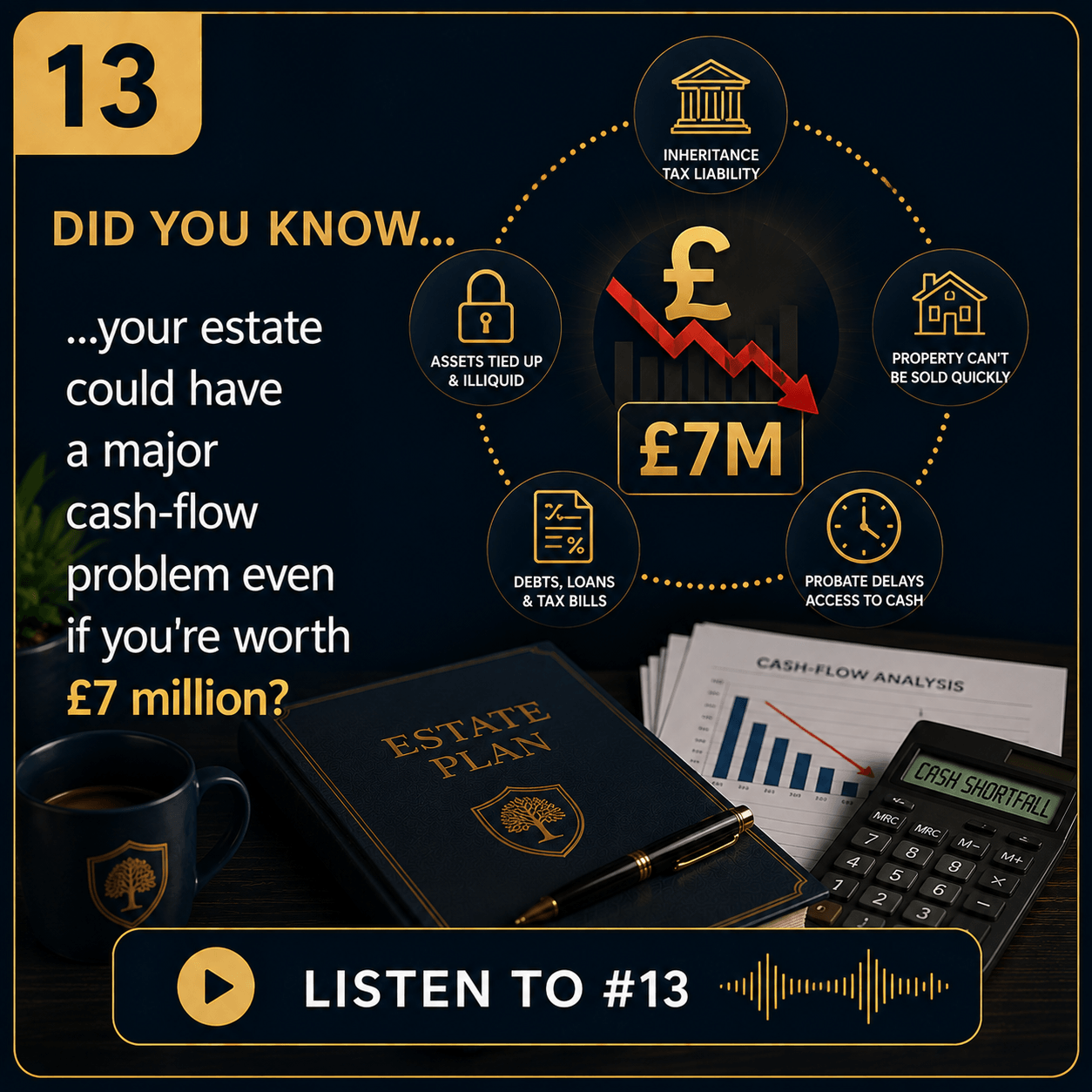
Somebody can die worth £7 million — and their family can still have a cash-flow problem.
Why?
Because wealth and liquidity are two completely different things.
Imagine an estate containing a £2 million family home, £3 million of investment properties, pensions, investments and other assets.
On paper, the family is extremely wealthy.
But how much money can the executors actually access when somebody dies?
Property is illiquid.
A business may be difficult to sell.
Some investments may take time to realise.
And assets held personally may become subject to the estate administration process.
Even cash sitting in a bank account isn't necessarily as immediately accessible to the family as it was while the account holder was alive.
And yet there may be a substantial inheritance tax liability to deal with.
That's where the problem begins.
How does a wealthy estate pay a large tax bill if most of the wealth isn't readily accessible?
Without proper planning, families may find themselves trying to raise money at exactly the wrong time.
They might have to borrow.
They might have to sell investments.
Or, in the worst circumstances, they may feel pressured into selling property or other assets more quickly than they otherwise would.
And that's exactly when disagreements can begin.
One beneficiary wants to sell.
Another wants to keep the property.
Somebody else thinks the price is too low.
Meanwhile, interest may be accumulating on unpaid inheritance tax.
That's why good estate planning needs to consider something called probate liquidity.
At Estate Architect, this forms part of what we call the Probate Liquidity Fund, or PLF.
The principle is straightforward.
Estimate the potential future liabilities and then establish how sufficient accessible funds could be available when the executors need them.
Depending on individual circumstances, specialist advisers may consider appropriate structures, insurance, investments, cash reserves or other planning solutions.
Where assets are legitimately structured outside the taxable estate, there may also be inheritance tax benefits, but that depends entirely on the particular structure and the applicable tax rules.
The important point is that the liquidity strategy should be designed before it's needed.
And any money earmarked specifically for probate liquidity needs to be managed with its purpose in mind.
The primary objective isn't necessarily maximum investment growth.
It's making sure the money is appropriately secure and accessible at the point it's required, taking account of investment and inflation risk.
Because having a £7 million estate doesn't necessarily solve a £1 million cash-flow problem.
The value of an estate is only one number.
A properly designed estate plan also asks:
“When the tax and other liabilities become payable, where is the money actually going to come from?”
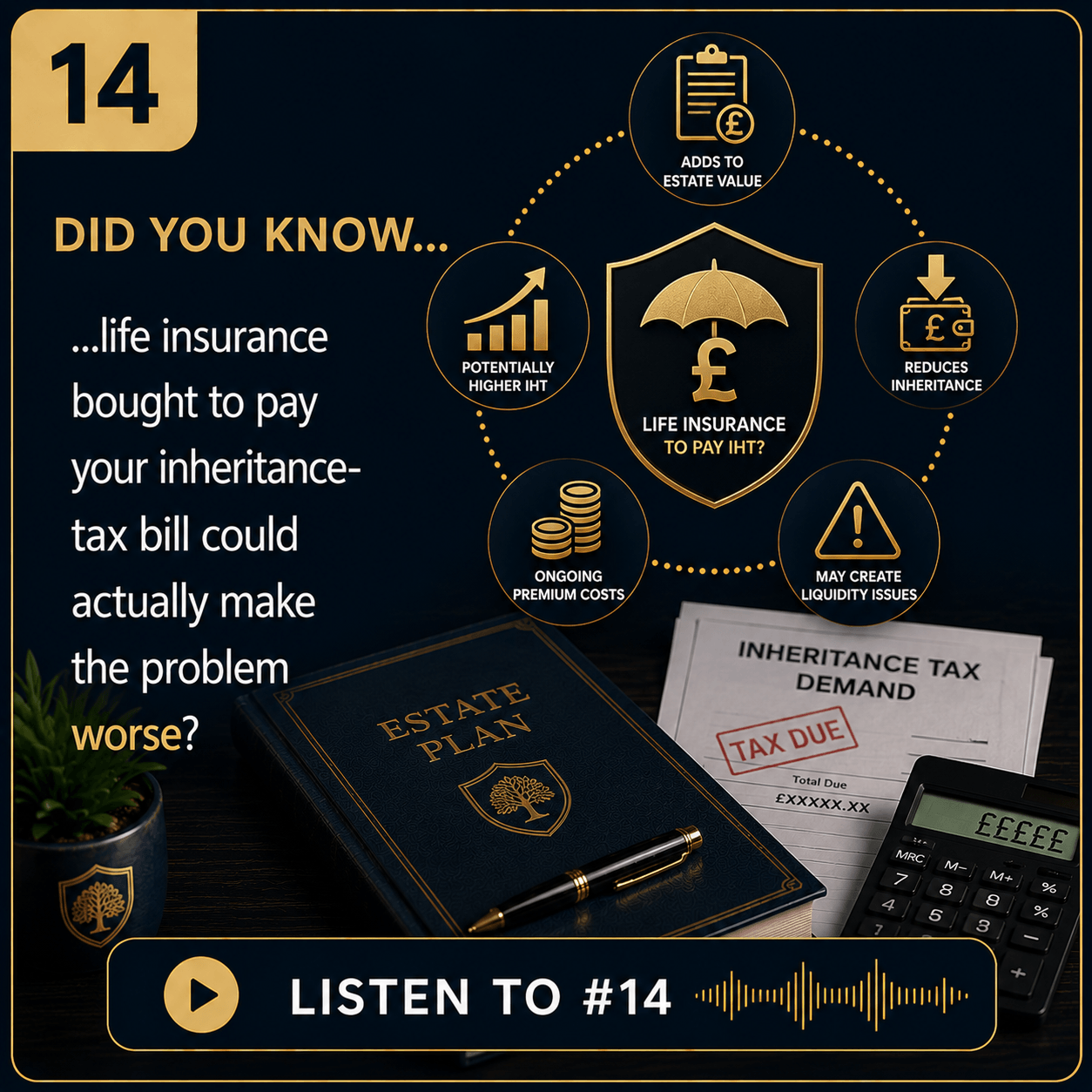
Life insurance sounds like one of the simplest solutions to inheritance tax.
Estimate the future tax bill.
Take out enough insurance to cover it.
And when somebody dies, the policy pays the tax.
Simple.
Except the detail really matters.
The first question is:
What type of life insurance has actually been purchased?
Someone might take out a 20-year term policy at 50 because they're relatively young and healthy and the premiums are affordable.
That policy provides valuable protection for those 20 years.
But what happens if they're still alive when the policy finishes at 70?
If they still need cover, obtaining a new policy at 70 could be considerably more expensive — and changes in health could affect the availability or cost of that cover.
Whole-of-life insurance can solve the expiry problem because, provided the policy remains in force and its conditions are met, it's designed to provide cover for life.
But naturally, that can come with significantly higher premiums.
Then there's another issue that many people completely overlook:
Where does the insurance payout actually go?
Imagine somebody has a potential inheritance tax liability and takes out a £500,000 life insurance policy to help pay it.
If that £500,000 is paid into their estate on death, it could itself increase the value of the taxable estate.
At a 40% inheritance tax rate, an additional £500,000 of taxable value could potentially create up to another £200,000 of inheritance tax, depending on the circumstances and available allowances.
So the policy that was supposed to solve the liquidity problem may have inadvertently increased the tax exposure.
And there's another practical problem.
The family needs the insurance money to help deal with the estate — so accessibility matters too.
That's why life policies used for estate planning are often considered alongside an appropriate trust arrangement, where suitable.
If correctly established, the proceeds may potentially be kept outside the deceased's estate and made available to the appropriate beneficiaries or trustees without having to form part of the probate estate.
But again, the structure matters.
What type of trust?
Who are the trustees?
Who are the beneficiaries?
What powers do the trustees have?
And how does everything interact with the wider estate plan?
Business owners may have additional options.
In certain circumstances, for example, a qualifying relevant life policy may allow a company to provide life cover for an employee or director in a tax-efficient way, subject to the relevant rules and specialist advice.
So life insurance can absolutely be a valuable estate-planning tool.
But buying a policy isn't the estate plan.
The type of policy, length of cover, premiums, ownership, trust structure, beneficiaries and eventual accessibility of the proceeds all need to work together.
Because the important question isn't simply:
“Do you have enough life insurance?”
It's:
“When that policy eventually pays out, will the money actually be in the right place, at the right time, for the right people to use it?”
That's the difference between simply having life insurance and having life insurance that's properly integrated into an estate plan.
One of the biggest mistakes people make with estate planning is thinking:
“We've done it. That's sorted.”
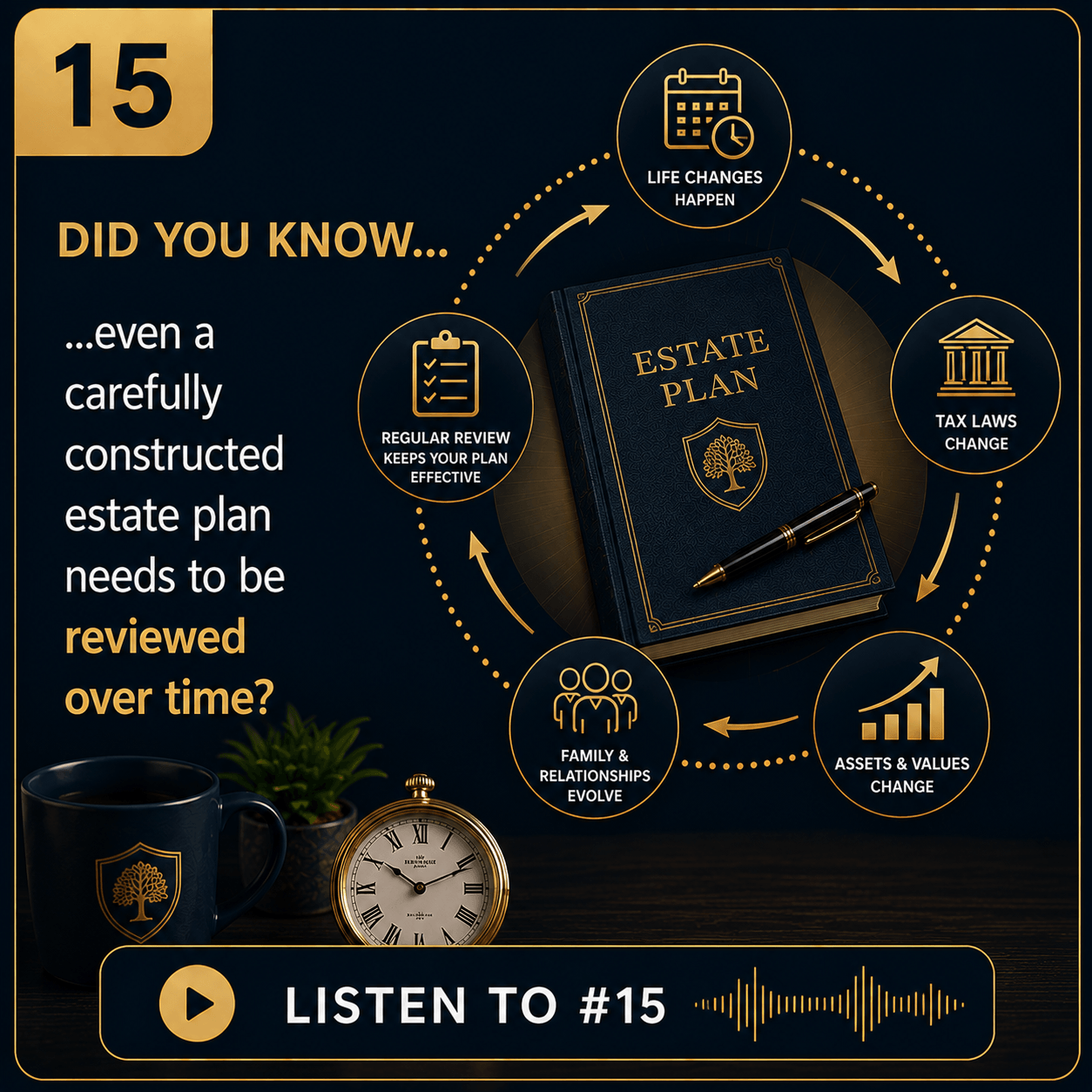
But an estate plan isn't something that should simply be created once and then forgotten about for the next 20 years.
Why?
Because almost everything the plan was originally based upon can change.
Property values change.
Investments grow or fall.
Pension values change.
Businesses grow, are sold or close.
And tax legislation changes.
But perhaps more importantly:
Families change.
Somebody gets married.
Somebody gets divorced.
Children or grandchildren are born.
A spouse dies.
Somebody retires.
A beneficiary's circumstances change.
Or perhaps somebody receives a substantial inheritance themselves.
Any one of those events could affect an estate plan.
And then there are decisions made by the individual.
What happens if they sell the family home?
Downsize?
Make a substantial gift?
Take a large amount from a pension?
Sell a business?
Move overseas?
Or restructure an investment portfolio?
The estate that exists today could look completely different in five or ten years.
And that's why estate planning isn't simply about creating the right structure.
It's about making sure that structure remains fit for purpose.
Think about buying a car.
It might be in perfect condition when it leaves the showroom.
But nobody expects to drive it for 15 years without servicing it, checking the tyres, changing the oil or carrying out an MOT.
Why should an estate containing potentially millions of pounds receive less attention?
Yet that's exactly what often happens.
A will was written 12 years ago.
A trust was established 15 years ago.
Beneficiary nominations were completed years ago.
And nobody has looked at any of it since.
That's why Estate Architect offers an ongoing service called Estate Control™.
Rather than simply implementing the estate plan and walking away, Estate Control provides a regular review of the important variables affecting the estate.
Changes in tax legislation.
Changes in asset values.
Changes in family circumstances.
Changes to the structures already in place.
And changes to the individual's own objectives.
The purpose is simple:
Keep the estate aligned with the plan.
A full restructuring shouldn't necessarily be required every year.
But checking the estate regularly can identify relatively small issues before they become expensive problems.
Because the best estate plan in the world is only designed around the circumstances and rules that existed when it was created.
Ten years later, the world may look very different.
Good estate planning isn't just about getting the structure right once.
It's about keeping it right as the assets, the family, the tax rules and life itself continue to change.
One of the biggest misconceptions about estate planning is:
“I'll deal with it when I'm older.”
People often think estate planning is something to start in their 70s or 80s.
But in many cases, the opposite is true.
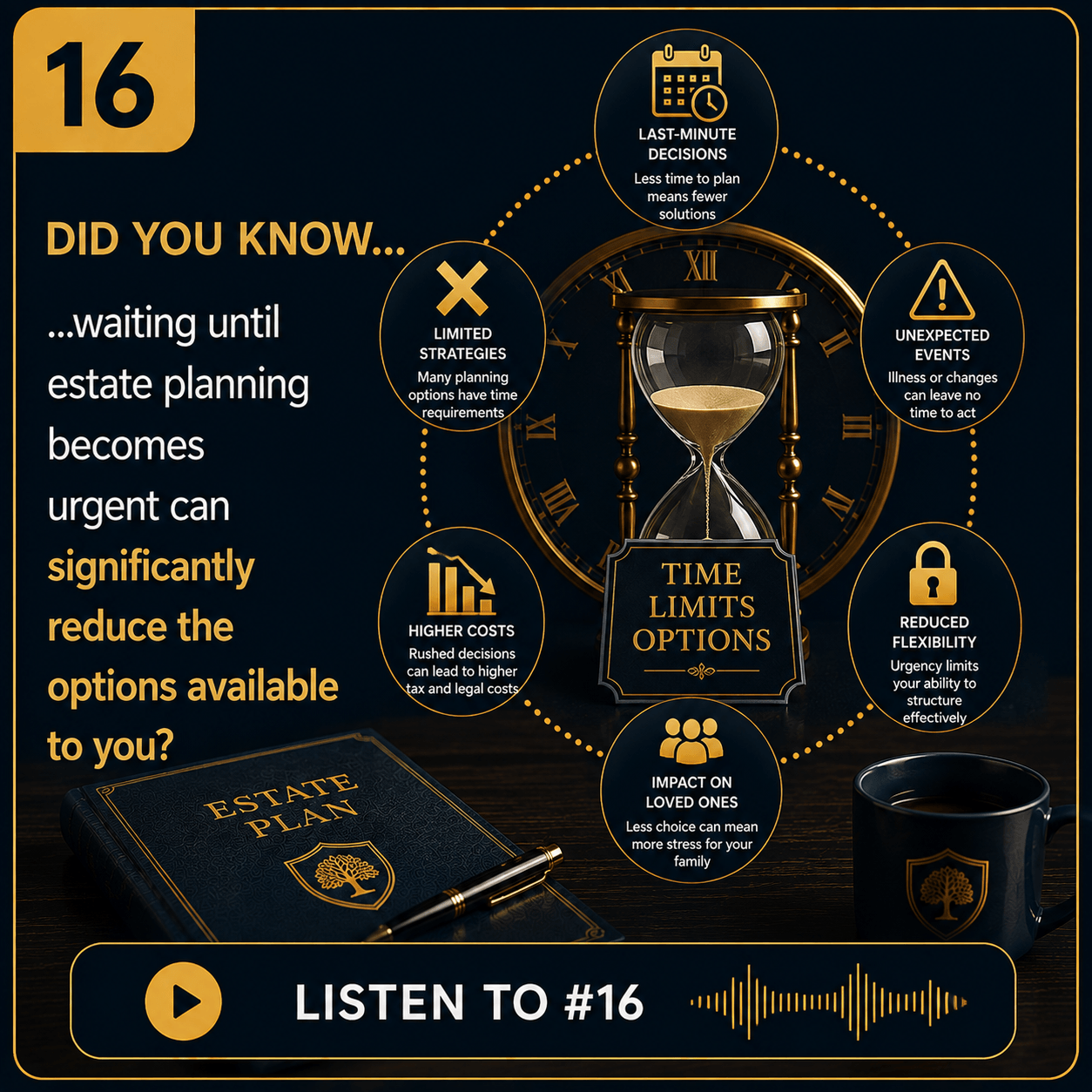
The earlier somebody starts planning, the more options they may have available.
Estate Architect works with people across a very wide age range — from people in their 40s through to people in their 80s and 90s.
And there's one lesson that comes up repeatedly:
Time is one of the most valuable assets in estate planning.
Why?
Because many planning strategies don't produce their full inheritance tax benefits immediately.
Some exemptions can potentially take effect straight away, subject to qualifying conditions.
Other reliefs and planning strategies may involve qualifying periods.
And substantial lifetime gifts can potentially involve the well-known seven-year inheritance tax rules.
So estate planning isn't something that should necessarily begin when somebody becomes seriously ill or reaches old age.
By then, some of the options that might have been available 10 or 20 years earlier may be less appropriate, more expensive or simply unavailable.
Take life insurance.
For somebody in their 40s or 50s, appropriate cover may potentially be easier or less expensive to obtain than it would be much later in life.
Or consider gifting.
Someone with decades ahead of them may have considerably more flexibility around long-term gifting strategies than somebody beginning the process very late in life.
And different stages of life create different opportunities.
Someone in their 40s may be accumulating wealth.
Someone in their 50s may have substantial property, investments and pensions and should increasingly understand their estate exposure.
Someone in their 60s may be approaching or entering retirement and restructuring income.
And somebody in their 70s or 80s may have completely different priorities around liquidity, control, gifting, property and financial security.
There isn't one strategy that works for every age.
And there isn't a point where somebody becomes “too old” to review their estate.
There may still be useful planning available.
But the available options can change significantly with age, health, financial circumstances and the prevailing tax rules.
That's why, as a general principle, Estate Architect believes that by the time somebody reaches their 50s — particularly where they have property, investments, pensions, businesses or children — their estate should already be properly organised and understood.
And for people with substantial assets, that conversation may need to start much earlier.
Because estate planning itself takes time.
Professional advisers need to be coordinated.
Structures need to be considered.
Documents need to be prepared.
Assets may need to be reorganised.
And some tax planning may take years rather than months to achieve its intended result.
That's why one of the most frustrating things to hear is:
“I wish we'd started this ten years ago.”
Nobody can create more time retrospectively.
So don't think of estate planning as something to do when it becomes urgent.
The best time to plan is while there's still plenty of time to choose.
Because in estate planning, time doesn't just reduce pressure. It creates options.
There's a misconception that serious estate planning is only for the exceptionally wealthy.
People with £10 million, £20 million or £50 million.
But actually, some of the estates that can be most vulnerable are much more ordinary.
Think about an estate worth between £1 million and £5 million.
That might sound like a lot of money.
But it doesn't necessarily mean somebody considers themselves wealthy.
They may simply have bought their family home 30 years ago and watched its value increase substantially.
Add some savings.
An ISA.
A pension.
Perhaps a buy-to-let property.
And suddenly an apparently ordinary family has accumulated an estate worth several million pounds.
And that's where things become interesting.
They're wealthy enough for inheritance tax and estate administration to become potentially significant problems.
But they may not be wealthy enough to think:
“We need sophisticated estate planning.”
So they continue with the professionals they've always used.
An accountant.
A solicitor.
A financial adviser.
All potentially excellent at their individual jobs.
But nobody necessarily looking at the entire estate.
Meanwhile, the tax rules can become less forgiving as the estate grows.
For example, the residence nil-rate band is subject to a taper once an estate exceeds the relevant threshold.
So relatively small increases in the value of an estate can sometimes have consequences that families simply weren't expecting.
But tax is only one issue.
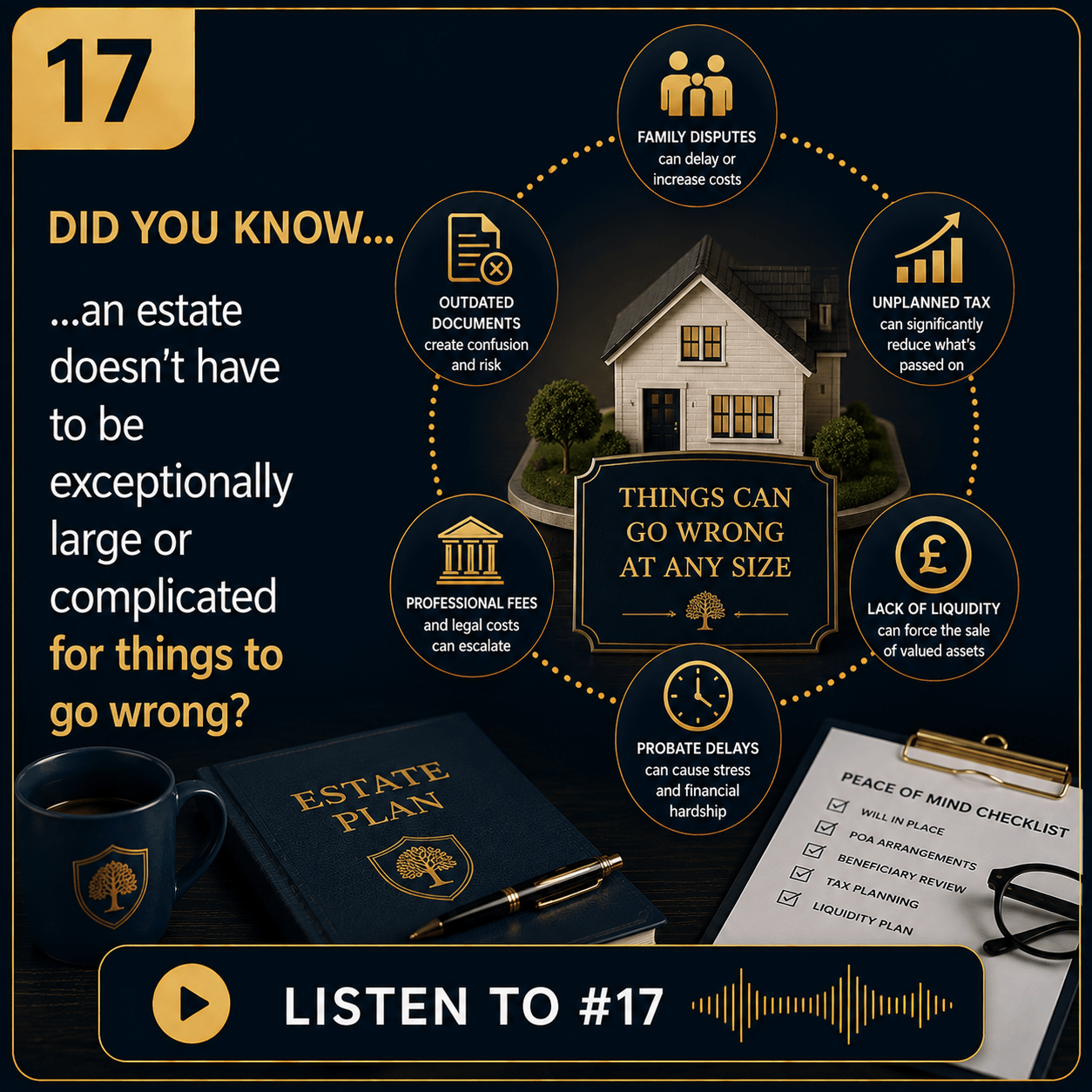
An estate doesn't even need to be particularly complicated for something to go wrong.
One missing document can create a problem.
One asset nobody can value.
One old trust that hasn't been reviewed.
One property overseas.
One private company.
One beneficiary with different needs.
One executor who doesn't know where anything is.
Or one blended family where children from previous relationships need to be treated appropriately.
Suddenly, an estate that looked perfectly straightforward isn't straightforward at all.
And that's the important point.
Estate complexity isn't determined simply by how many millions somebody has.
A £20 million estate may already have specialist tax advisers, lawyers and wealth planners constantly reviewing it.
Meanwhile, a £2 million estate might have received virtually no coordinated estate planning whatsoever.
Yet a mistake involving even 10% of that estate represents £200,000 of family wealth.
That's why Estate Architect doesn't simply ask:
“How wealthy are you?”
The better questions are:
How is the estate structured?
What assets are inside it?
How much could potentially be exposed to inheritance tax?
How easy would it be to administer?
What happens on first and second death?
And what family complications need to be considered?
Because an estate doesn't need to be exceptionally wealthy to create an exceptionally expensive problem.
Sometimes the families most exposed are the ones who never thought they were wealthy enough to need proper estate planning in the first place.
When people think about estate planning, they usually think about one objective:
Reducing inheritance tax.
But good estate planning should look much further than the tax bill.
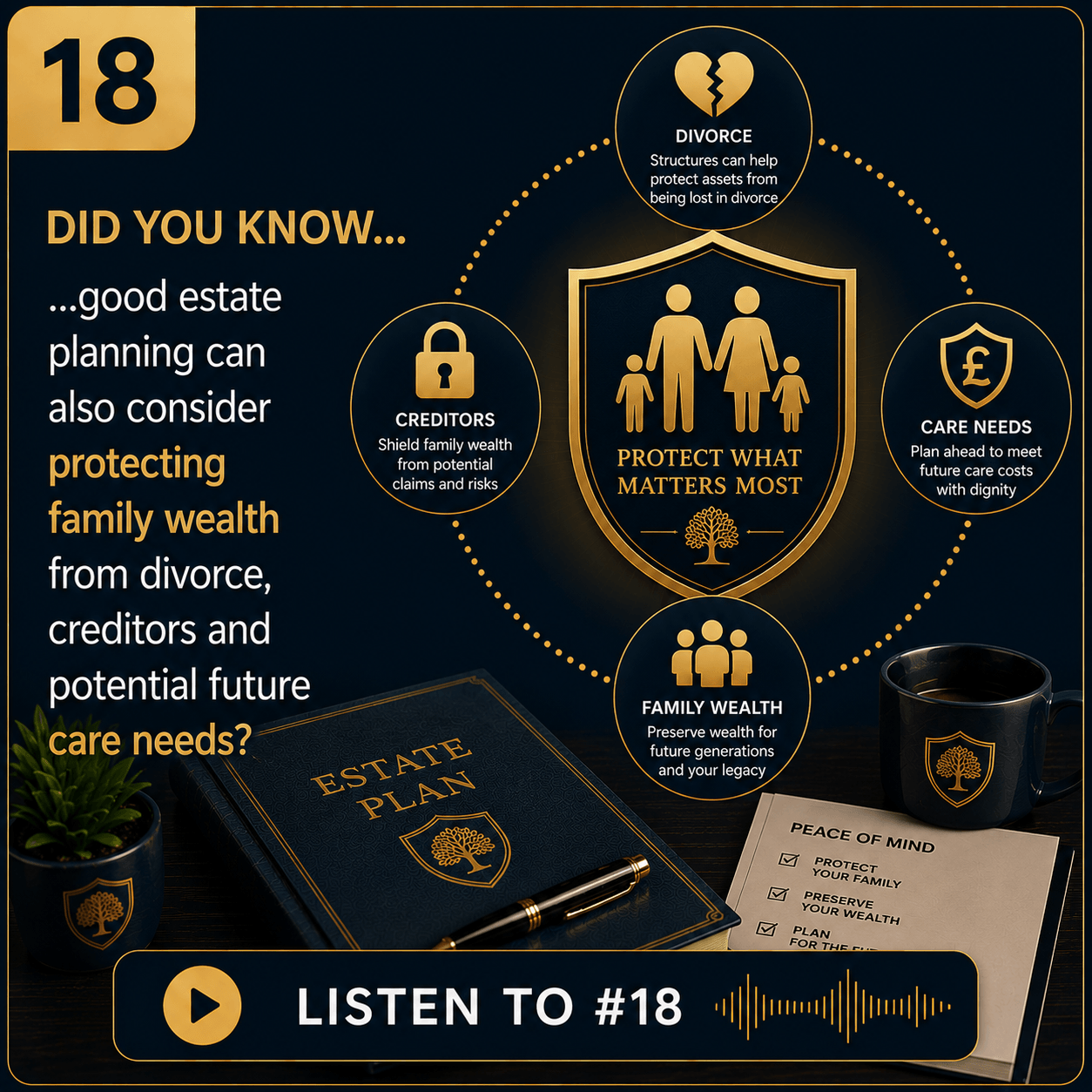
At its heart, estate planning is also about asset protection.
Because there's little point creating a structure that potentially saves inheritance tax in 20 years if it creates completely different risks during somebody's lifetime.
Think about what can happen over several decades.
A business owner could face a commercial dispute or creditor.
A child who eventually receives substantial family wealth could subsequently divorce.
A beneficiary could experience financial difficulties.
Family circumstances could change.
Or somebody may require significant care later in life.
These are all risks that can affect family wealth.
And that's why simply giving assets away isn't necessarily the answer.
Imagine parents give £500,000 outright to their child.
The asset has left the parents' ownership.
But what happens next?
The child might subsequently divorce.
They might become bankrupt.
They might die unexpectedly.
Or circumstances within the family could change completely.
The inheritance tax question may have been addressed, but another risk may have been created.
That's where proper structuring becomes important.
Depending on the circumstances, specialist advisers may consider structures such as trusts, companies, partnerships or other arrangements designed to achieve particular objectives around ownership, control, succession and protection.
But there isn't one magic structure that makes assets untouchable.
Different risks have different legal rules.
Inheritance tax has its rules.
Divorce courts have their rules.
Creditors and insolvency have their rules.
And local authorities have specific rules when assessing somebody's ability to fund care, including provisions dealing with deliberate deprivation of assets.
So good estate planning should never be about artificially hiding assets or simply moving them somewhere in the hope that nobody can reach them.
It's about legitimate, long-term planning carried out for the right reasons and with appropriate legal, tax and regulated financial advice.
At Estate Architect, the question isn't simply:
“How can the future inheritance tax bill potentially be reduced?”
It's also:
How can the individual remain financially secure?
How should ownership and control be structured?
How can wealth ultimately pass to beneficiaries appropriately?
What happens if family circumstances change?
And what other risks need to be considered before anything is implemented?
Because reducing inheritance tax is valuable.
But protecting family wealth requires a much wider view.
Good estate planning doesn't look at one future tax bill in isolation.
It looks at the risks surrounding the wealth throughout its entire journey — during the owner's lifetime, through succession and ultimately into the hands of the next generation.
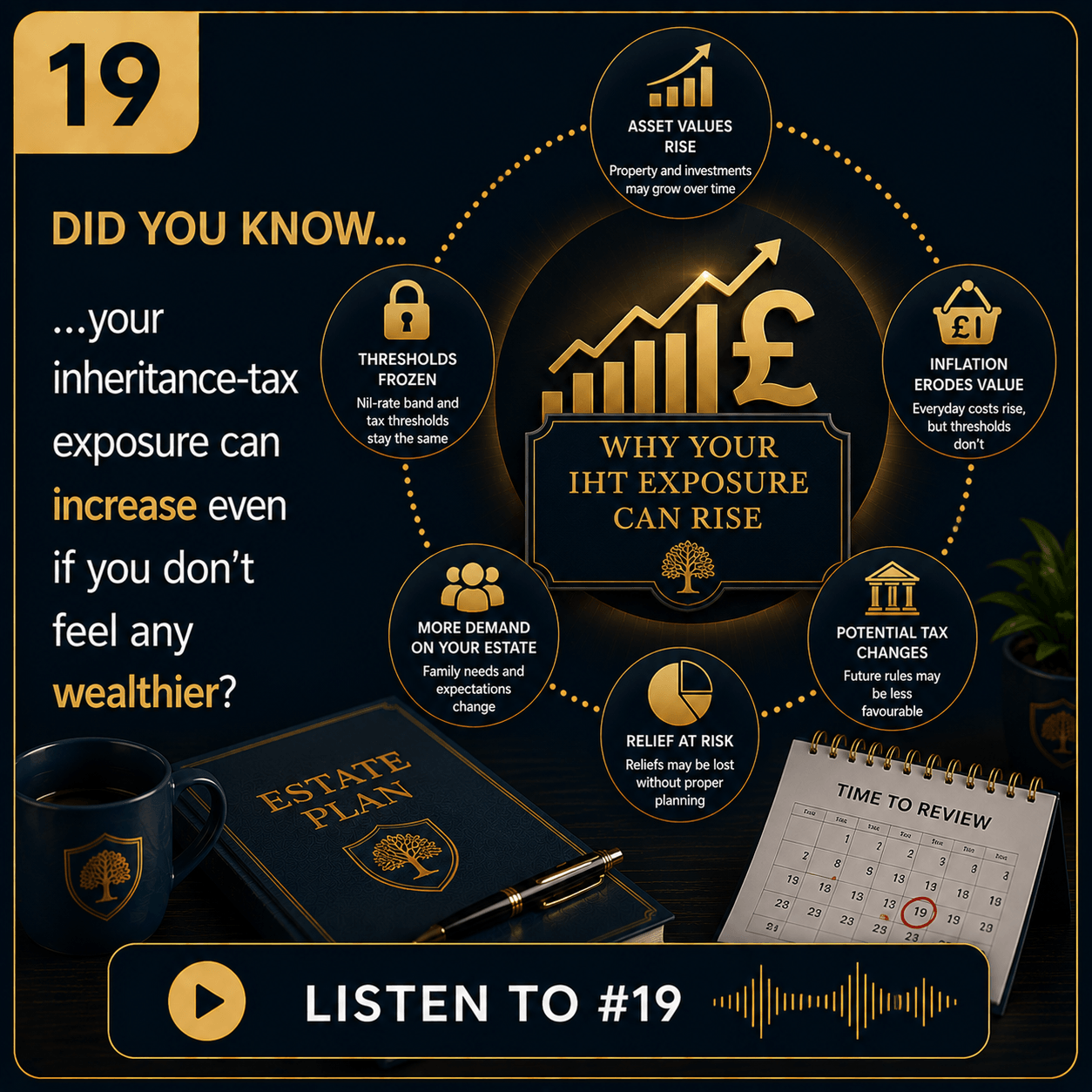
Most people assume their inheritance tax bill only becomes bigger because they're becoming wealthier.
But that's not necessarily what's happening.
The important distinction is between nominal wealth and real wealth.
Imagine somebody owns the same house for 30 years.
They haven't bought another property.
They haven't added another bedroom.
They haven't necessarily done anything to increase their wealth.
But the property itself may have increased dramatically in value.
The same thing can happen with investments and pensions.
Over long periods, property and investment markets have historically tended to increase in nominal value, although returns are never guaranteed and certainly don't increase by the same amount every year.
So imagine an estate worth £2 million today.
If, purely as an illustration, it grew at around 7% a year, it would approximately double every ten years.
That means £2 million could become approximately £4 million in ten years and potentially around £8 million in twenty years.
Has the family necessarily become four times wealthier in terms of what that money can actually buy?
No.
Inflation may have increased the price of almost everything else at the same time.
But inheritance tax is calculated using the nominal value of the assets at the relevant time, subject to the rules and allowances then applying.
And that's where another problem appears.
What happens when asset values increase faster than inheritance tax thresholds?
More and more of the estate can potentially become exposed to inheritance tax.
This is sometimes described as fiscal drag.
And there's another practical difficulty.
Once somebody has accumulated a substantial estate, it can become surprisingly difficult to spend wealth faster than the assets themselves are growing.
Take somebody with a £3 million estate.
If their property, investments and other assets increased substantially during a particular year, are they really going to spend hundreds of thousands of pounds simply to stop the estate becoming larger?
And should they?
Of course not.
That's not sensible estate planning.
And remember, the inheritance tax exposure being considered isn't necessarily today's tax bill.
It's the potential tax position when inheritance tax eventually becomes relevant.
For a married couple in their 60s, that could potentially be 10, 20 or even 30 years into the future.
That's a very long period for property, investments, tax legislation and allowances to change.
So looking at today's estate and saying:
“The inheritance tax bill doesn't look too bad” can be misleading.
The better question is:
“What could this estate look like when the tax eventually becomes payable?”
Nobody knows exactly what property prices, investment returns or tax legislation will look like decades from now.
That's why good estate planning uses different assumptions and stress-tests different scenarios rather than pretending the future can be predicted precisely.
Because the real inheritance tax problem isn't necessarily the liability somebody can see today.
It's the liability that may be quietly developing over the next 10, 20 or 30 years.
This might sound like a bold statement.
And actually, it surprised Estate Architect too.
Search Google.
Search LinkedIn.
Look through financial services firms, estate planners, wealth managers, solicitors and tax specialists.
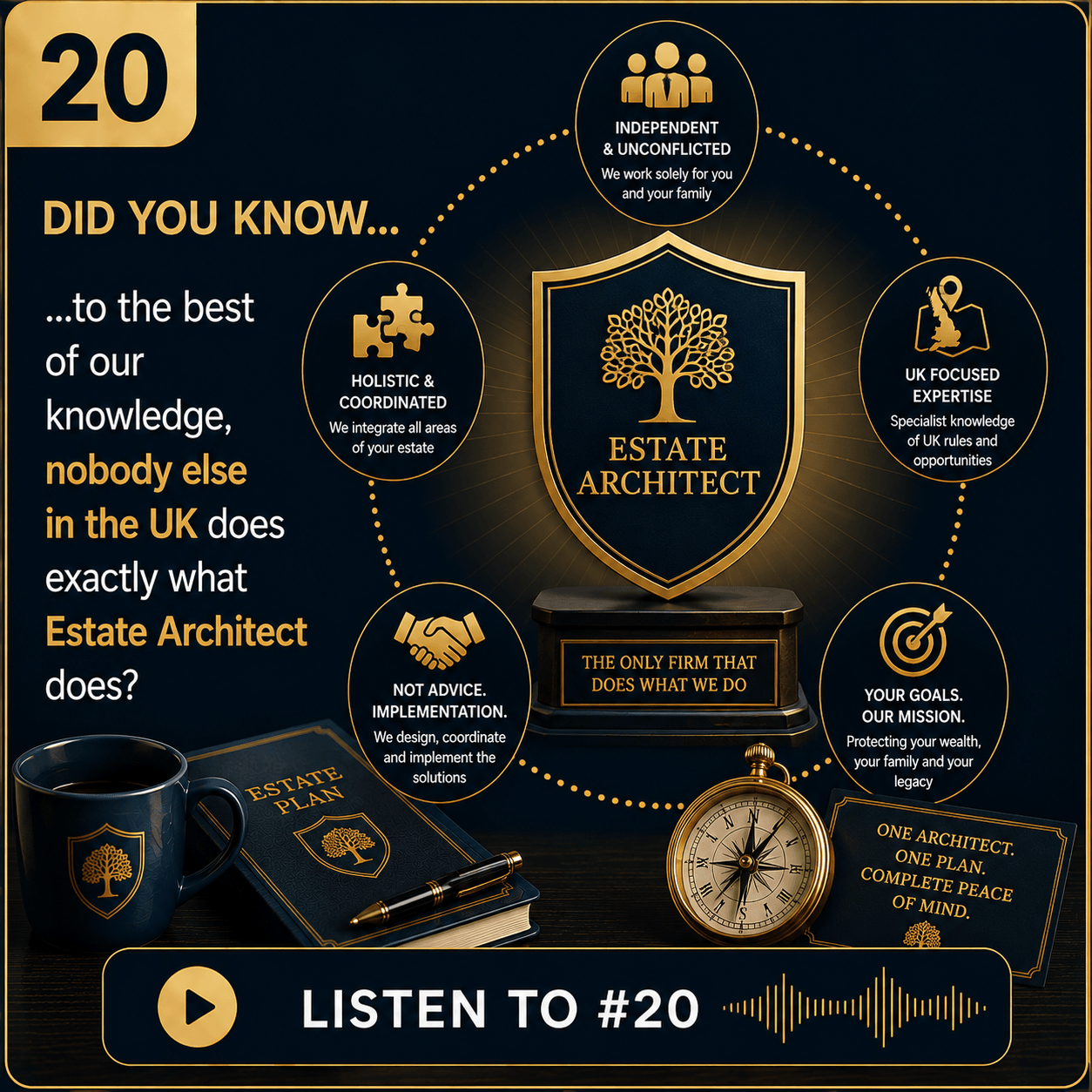
To the best of our knowledge, we haven't found another UK business operating in exactly the same way as Estate Architect.
That's not to say one doesn't exist.
There may well be somebody somewhere doing something similar.
But we haven't found them.
And perhaps there's a reason for that.
Very wealthy families have been doing something similar for generations.
If somebody has a £20 million, £50 million or £100 million estate, they may have access to a family office.
And within that family office there can be tax specialists, lawyers, investment professionals, property specialists and other advisers whose job is to look across the family's entire wealth.
But what happens to somebody with a £2 million, £3 million or £5 million estate?
Typically, they have three professionals.
An accountant. A solicitor. And a financial adviser.
Each may be very good at their individual job.
But who's bringing everything together?
That's the gap Estate Architect was created to fill.
Estate Architect itself doesn't provide regulated financial advice, legal advice or tax advice.
Instead, its role is different.
Estate Architect designs, coordinates and manages the overall estate implementation.
And behind that sits a network of specialists covering different disciplines.
Depending on what an individual estate requires, that could include tax specialists, solicitors, barristers, trust specialists, pension advisers, investment professionals, mortgage advisers, property specialists, surveyors, probate specialists, insurance specialists, business-structuring experts and other appropriately qualified professionals.
The client doesn't have to start from scratch.
They don't have to search Google for ten different specialists.
They don't have to interview everybody individually and then try to work out whether all those professionals' recommendations fit together.
And most importantly, they don't have to become the project manager of their own estate.
Estate Architect remains involved throughout the implementation.
It helps identify what needs to be done.
It brings in the appropriate specialists.
It coordinates meetings.
It keeps the different workstreams moving.
And it looks across the entire estate to make sure the individual pieces form part of one coherent plan.
Think again about building a house.
The architect doesn't lay every brick.
The architect doesn't install the plumbing.
And the architect doesn't wire the electricity.
Specialists do those jobs.
But somebody still needs to understand the complete design and coordinate how everything fits together.
That's Estate Architect.
And there's another reason the model is unusual.
It's deliberately personal.
Estate Architect isn't designed as a mass-market service where thousands of clients are pushed through an automated process.
Ranjeet works directly with clients and their professional teams, drawing on almost three decades of experience across financial markets, business and financial services.
That naturally limits the number of estates that can be worked on at any one time.
But that's also the point.
Because complicated estate planning isn't simply about buying a product or receiving one piece of advice.
It's about bringing together property, pensions, investments, tax, legal structures, liquidity, administration, governance and family circumstances into one coordinated strategy.
That's why Estate Architect exists.
Not to replace every specialist adviser.
But to be the architect that brings the specialists together.
And, to the best of our knowledge, we have yet to identify another UK firm offering exactly the same integrated model.
How Many Did You Know?
If some of these questions made you think differently about your estate, perhaps it's worth having a conversation.
You don't need to know exactly what you need.
You don't need to prepare anything.
And there's no obligation to proceed.
Simply book a complimentary call with Estate Architect and tell us a little about your circumstances.
We'll listen, ask a few questions and help you understand whether there are areas of your estate that may warrant a closer look.
Estate Architect provides educational research and analysis relating to inheritance tax and estate planning concepts for UK residents. We do not provide regulated investment, tax, or legal advice and are not authorised or regulated by the Financial Conduct Authority (FCA). Where regulated advice is required, introductions may be made to authorised professionals.
© Estate Architect 2026