Specialist Reports & Guides
Practical reports, research papers and educational guides designed to help families better understand inheritance tax, pensions and long-term wealth protection.
Most families spend years building wealth.
Very few spend time understanding the risks surrounding it.
Over the years I noticed that many families were asking similar questions:
How much inheritance tax could my family face?, What happens to pensions?, Are there structural weaknesses I cannot see?, Have we actually organised everything properly?
The problem was never a shortage of information. The problem was knowing where to look.
That is why we created our Reports Library.
A growing collection of specialist reports and educational guides designed to simplify complex estate planning topics and help families make more informed decisions.
No Strings Attached
We created this report library to make inheritance tax and estate planning easier to understand, without barriers, pressure or obligation.
That means no payment, no subscriptions, no email forms and no phone calls. Simply click, read and explore the content freely.
Our goal is straightforward: to provide practical educational resources that help families make better-informed decisions and understand the planning issues that quietly affect many estates.
And if a time comes when you need support, guidance or a deeper review, you’ll know where to find us.
No sales. Just helping.
Start Exploring
The Estate Architect Inheritance Tax Library
34 reports covering inheritance tax planning, pensions, trusts and wealth protection.

Understanding the 2027 Pension Changes and Their Impact on Estates
Download the Inheritance Tax Report to explore how structured planning may help families navigate the evolving rules.

What is
Inheritance Tax?
If you’ve ever wondered how something that began as a tax on the rich ended up punishing ordinary families, you only need to look at the history of inheritance tax.
The 7 Pillars of
IHT Planning
The 7 Pillars of IHT Planning explores how pension tax changes could affect family wealth and highlights key strategies for protecting long-term legacy.

The New
Pension 2027 Trap
Pensions are often the second-largest family asset, and from April 2027 they could become a major inheritance tax concern.
The 40% Tax
That's Really 75%
Inheritance tax does not always increase through higher rates. Frozen thresholds combined with rising asset values quietly pull more families into the tax system over time.

Pension Scandal - £1 Million to £360k
A £1 million pension may no longer deliver £1 million of family value. Multiple layers of taxation could significantly reduce what ultimately reaches the next generation.

Strategy 1 - Gifting is not as Great as You Think
Governments often introduce small allowances and exemptions alongside tax changes, but while these incentives can help, they rarely address the larger inheritance tax challenges many families face.

Strategy 2 - Protecting the Home
For many families, the home is their largest asset and biggest source of wealth. Yet many underestimate how vulnerable that value can become due to misconceptions and overlooked inheritance tax risks.

Strategy 3 - Trusts
Trusts are one of the most discussed areas of inheritance tax planning, yet many families misunderstand how they work and underestimate the role they can play within a wider estate structure.

Strategy 4 - Business Property Relief
A familiar pattern is emerging: when tax-efficient strategies become too effective, governments often move to restrict them. Trusts, pensions and now Business Property Relief have all faced increased scrutiny.

Strategy 5 - Life Insurance Secrets
Life insurance is often overlooked in inheritance tax planning, yet when structured correctly it can provide a simple way to help cover an inheritance tax bill without forcing families to sell assets.

Strategy 6 - Equity Release
Equity release was once viewed as a popular inheritance tax strategy, helping families reduce estate value while remaining in their home. Although rules and planning considerations have evolved, it can still play a role when used within the right structure.

Strategy 7 - Easy Wins
Some of the most effective inheritance tax strategies are often the simplest. Small, practical steps taken consistently over time can quietly make a meaningful difference without complex planning.

Strategy 8 - Charity
Charitable giving can play an important role in inheritance tax planning, offering potential tax advantages while helping families create a lasting impact beyond financial wealth.

Advanced Strategies - £2-10m Estates
Inheritance tax is no longer just a concern for the very wealthy. Rising property values and changing pension rules mean more families are now being drawn into the system, making proactive planning increasingly important.
Advanced Strategy 1 - Non-Domicile & International Planning
For decades, many wealthy families have used domicile planning as part of broader inheritance tax strategies, taking advantage of rules that historically treated overseas assets differently under the UK tax system.

Advanced Strategy 2 – Agricultural & Woodland Relief
Farmland is often overlooked in inheritance tax discussions, yet it can represent one of the most valuable and quietly powerful asset classes within long-term estate planning.
Advanced Strategy 3 – Offshore Annuities & Bonds
Some pension strategies remain poorly understood, despite historically being viewed as highly effective tools for inheritance tax planning and passing wealth outside the estate.

Advanced Strategy 4 – Alternative Assets
Inheritance tax planning is not always about obvious rules. Between the black-and-white areas lies a space where creative thinking and carefully structured opportunities can emerge.

Advanced Strategy 5 – Private Equity & EIS
Private equity and EIS planning are often associated with inheritance tax relief, but their potential extends beyond tax efficiency into long-term wealth building and legacy creation.
Advanced Strategy 6 - International Trusts & Wealth Structuring
Offshore planning is often misunderstood. When structured correctly, it can form part of a legitimate wealth and estate strategy designed to improve efficiency and long-term asset protection.

Advanced Strategy 7 - Loan Trusts
Some inheritance tax strategies aim to reduce future tax exposure while allowing families to retain control and flexibility over their wealth.

Mistake 1 – When AIM & BPR Backfire
Even well-intentioned inheritance tax planning can go wrong when strategies are poorly structured. Good intentions alone are not enough; execution and proper planning matter.
Mistake 2 – House Gifting Gone Wrong
Some of the biggest inheritance tax mistakes are made with the best intentions. Families often act out of love and a desire to protect future generations, but good intentions without the right structure can create unintended consequences.

Mistake 3 – The Mis-Sold Policy
Life insurance can begin as a simple way to protect loved ones, but without careful planning changing circumstances and rising costs can sometimes create unexpected challenges.

Mistake 4 – Poor Advice from a Financial Adviser
Trust plays a central role in financial decisions, yet many people rely on professionals and institutions without fully understanding the details, which can sometimes lead to costly mistakes.
Mistake 5 –
The 7-Year Trap
The seven-year rule may sound simple, but small misunderstandings can create costly consequences, showing how even well-intentioned inheritance tax planning can go wrong.

Mistake 6 – The Forgotten Form
Even small oversights in estate planning can have major consequences. Sometimes a forgotten document or missing paperwork can create unexpected inheritance tax costs for the family left behind.

Mistake 7 – The Family Accountant Trap
Long-standing relationships can create trust and comfort, but in inheritance tax planning familiarity alone does not always guarantee the right expertise or wider strategic oversight.
Who Not to Trust for IHT Advice
Many inheritance tax mistakes begin with advice that focuses on a specific product rather than the bigger picture, highlighting the importance of strategy and broader estate oversight.

Why an IHT Consultant Beats an IHT Specialist
One of the most common inheritance tax mistakes is jumping straight to a specialist before understanding the real problem. Different assets often require different solutions and different expertise.

Ready to Protect Your Family’s Future
If you’ve reached this point, you already understand that inheritance tax is becoming an increasingly important issue, and many families recognise that delaying action may no longer be the best option.
The Final Third — A Personal Thank You
Reaching this point suggests you are taking inheritance tax seriously and thinking carefully about your family’s future. Over the years, I’ve noticed that when it comes to inheritance tax planning, most people tend to fall into three groups.

Smart Planning Never Stands Still
Reaching the end of this series shows a real commitment to understanding inheritance tax and protecting your family’s future. One important lesson remains: inheritance tax planning is not a one-time exercise, because rules change and strategies need to evolve over time.
Pension Wealth and
the 2027 Inheritance
Tax Change
For many years pensions have been among the most tax-efficient structures available to UK investors, allowing capital to grow free from capital gains tax and income tax while held within the wrapper.
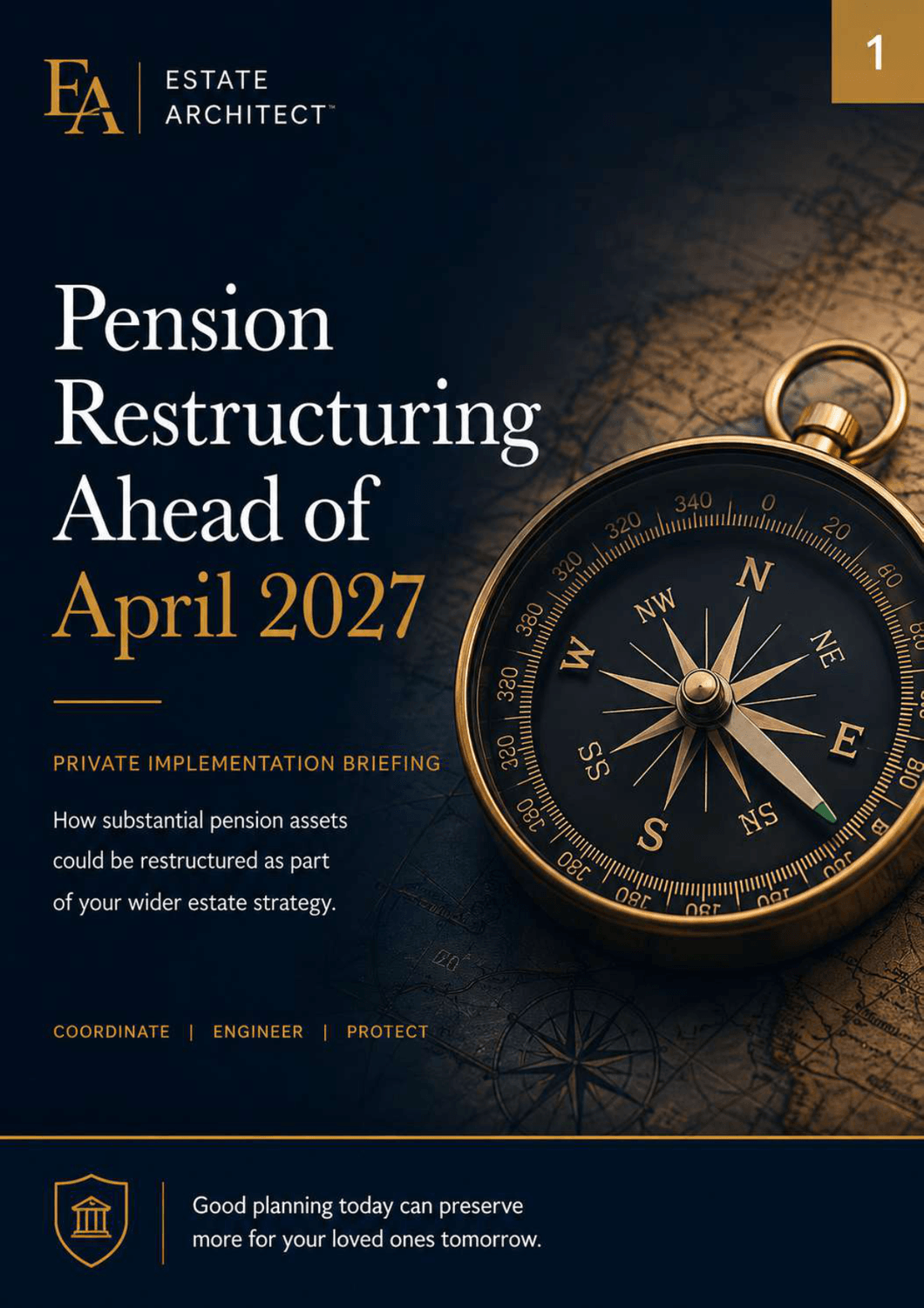
Pension Restructuring Ahead of April 2027
From 6 April 2027, most unused pension funds and pension death benefits are expected to fall within the scope of Inheritance Tax. This creates a material issue for individuals with substancial pension assets.
Private Estate Briefings
Six educational briefings designed to simplify complex estate planning topics.

Briefing 1 The Reality Check
This briefing explains why inheritance tax is becoming a growing concern for more families and why early estate planning is about protecting wealth, family and long-term security.

Briefing 2 The Hidden Gaps
This briefing explains why inheritance tax planning often becomes fragmented and why protecting an estate requires someone looking at the bigger picture, not just individual pieces.
Briefing 3 The Market Insider System Part 1
This briefing explains how years of reviewing estates revealed recurring weaknesses and why the Three Pillar Framework was created to bring structure, protection and coordination into one integrated system.

Briefing 3 The Market Insider System Part 2
This briefing explains why modern estate planning has become increasingly complex and why larger estates often require specialist coordination to bring multiple moving parts together.

Briefing 4 The 300,000 Blindsport Part 1
This briefing explores a real-life case study showing how significant inheritance tax exposure can remain hidden, even when multiple advisers are already in place.
Briefing 4 The 300,000 Blindsport Part 2
This briefing explains why inheritance tax planning can often deliver greater long-term impact than traditional investing by protecting wealth rather than simply trying to grow it.
Briefing 5
The Cost of Waiting
This briefing explains why timing plays a critical role in inheritance tax planning and how delaying action can quietly reduce options while increasing long-term tax exposure.
Briefing 6 The Diagnostic Estate Assessment Part 1
This briefing explains why effective estate planning starts with a full Diagnostic Assessment, helping identify hidden risks, structural weaknesses and opportunities before building a coordinated long-term strategy.
Briefing 6 The Diagnostic Estate Assessment Part 2
This briefing explains why the Diagnostic Estate Assessment forms the foundation of effective estate planning by identifying risks, revealing structural weaknesses and creating clarity before important decisions are made.
Educational purposes only. Estate Architect does not provide regulated financial, tax or legal advice. Personal circumstances vary and specialist advice should be obtained where appropriate.
Estate Architect provides educational research and analysis relating to inheritance tax and estate planning concepts for UK residents. We do not provide regulated investment, tax, or legal advice and are not authorised or regulated by the Financial Conduct Authority (FCA). Where regulated advice is required, introductions may be made to authorised professionals.
© Estate Architect 2026
Access This Report Free
This report forms part of our educational 32-Part Inheritance Tax Series, designed to help families better understand inheritance tax planning, pensions and long-term wealth protection.
Simply enter your details below for complimentary access.
You’ll receive:
✓ Instant access to this report
✓ Access to selected resources from the IHT Series
✓ Future inheritance tax updates and new releases
✓ Educational insights and specialist content
No payment required. No obligation.
Educational resources only. You can unsubscribe at any time.
We HATE spam. Your email address is 100% secure
Protect Your Family’s Wealth — Before HMRC Takes Its Share
Download the Inheritance Tax Report and learn how successful families are protecting their estates using
The Seven Pillars of IHT Planning.
This report is for educational purposes only and does not constitute financial, tax or legal advice. Tax treatment depends on individual circumstances and may change. Please seek appropriate professional advice before making decisions.
By submitting your details, you agree to receive related communications. You can unsubscribe at any time.
We HATE spam. Your email address is 100% secure