Probate Liquidity Fund™
Risk Three
Your Family Can't Access Your Wealth When They Need It Most
One of the greatest misconceptions in estate planning is that if you have a valuable estate, your family will automatically have enough money to settle your affairs.
Unfortunately, the opposite is often true.
Many estates are asset rich but cash poor.
A family may own a £2 million home, a successful business, investment portfolios and substantial pension assets, yet when the first death occurs, very little of that wealth is immediately available.
Bank accounts may be frozen.
Property cannot usually be sold overnight.
Businesses require valuation.
Investments may remain inaccessible until probate has progressed.
Yet HMRC expects Inheritance Tax to be paid long before many of these assets can be realised.
This creates one of the biggest financial pressures your executors will ever face.
The Probate Liquidity Fund™ has been designed to solve this problem before it happens.
Where appropriate, we help restructure part of your estate so that liquidity is available outside your taxable estate, giving your executors immediate access to funds when they need them most.
This means your family can administer your estate from a position of strength rather than being forced into difficult financial decisions.

Why This Matters
One of the most common reasons families make poor decisions during probate is because they simply need money quickly.
Without available liquidity they may have little choice but to:
Sell the family home.
Dispose of investments at the wrong time.
Sell business interests below market value.
Borrow money.
Delay paying HMRC.
Disagree over which assets should be sold first.
These decisions are rarely made because they are the best option.
They are made because there appears to be no alternative.
The Probate Liquidity Fund™ gives your family that alternative.
Illustrative Example


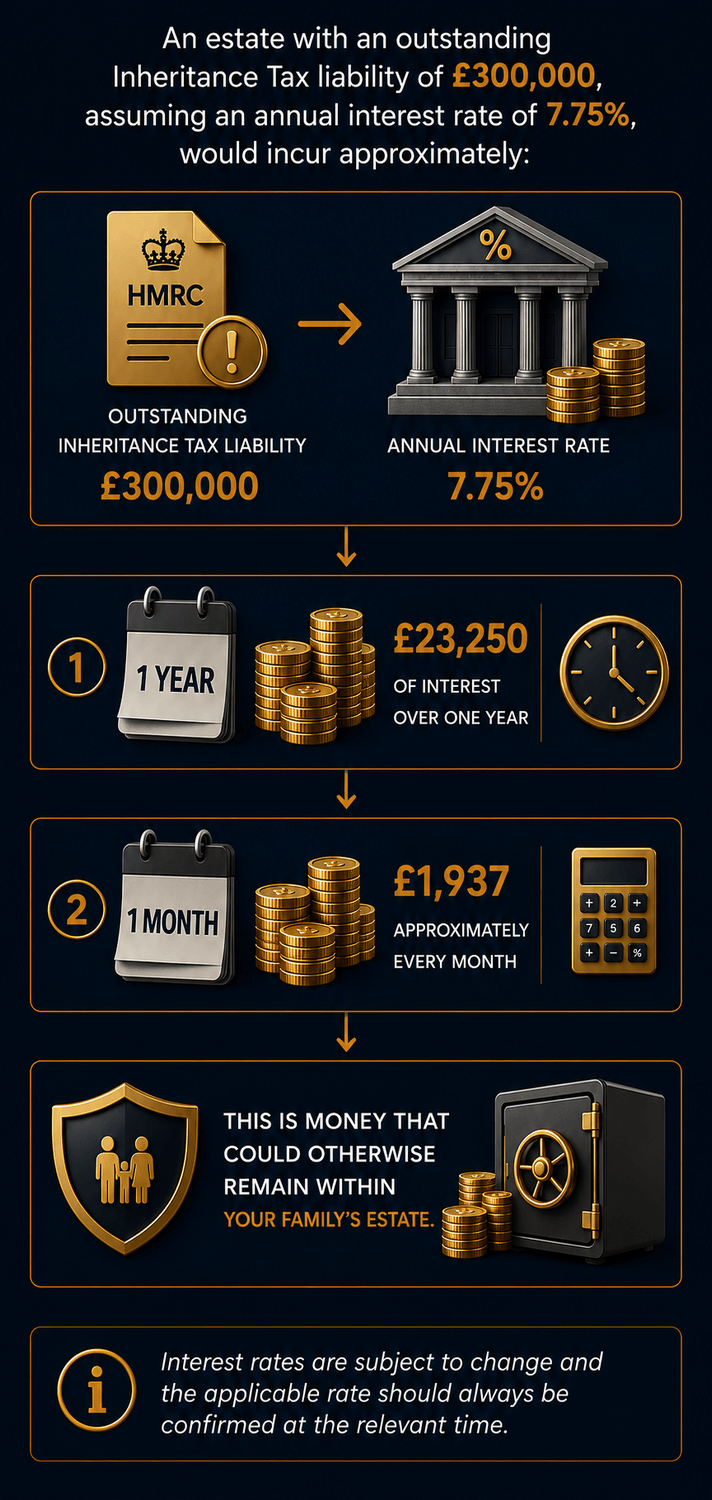
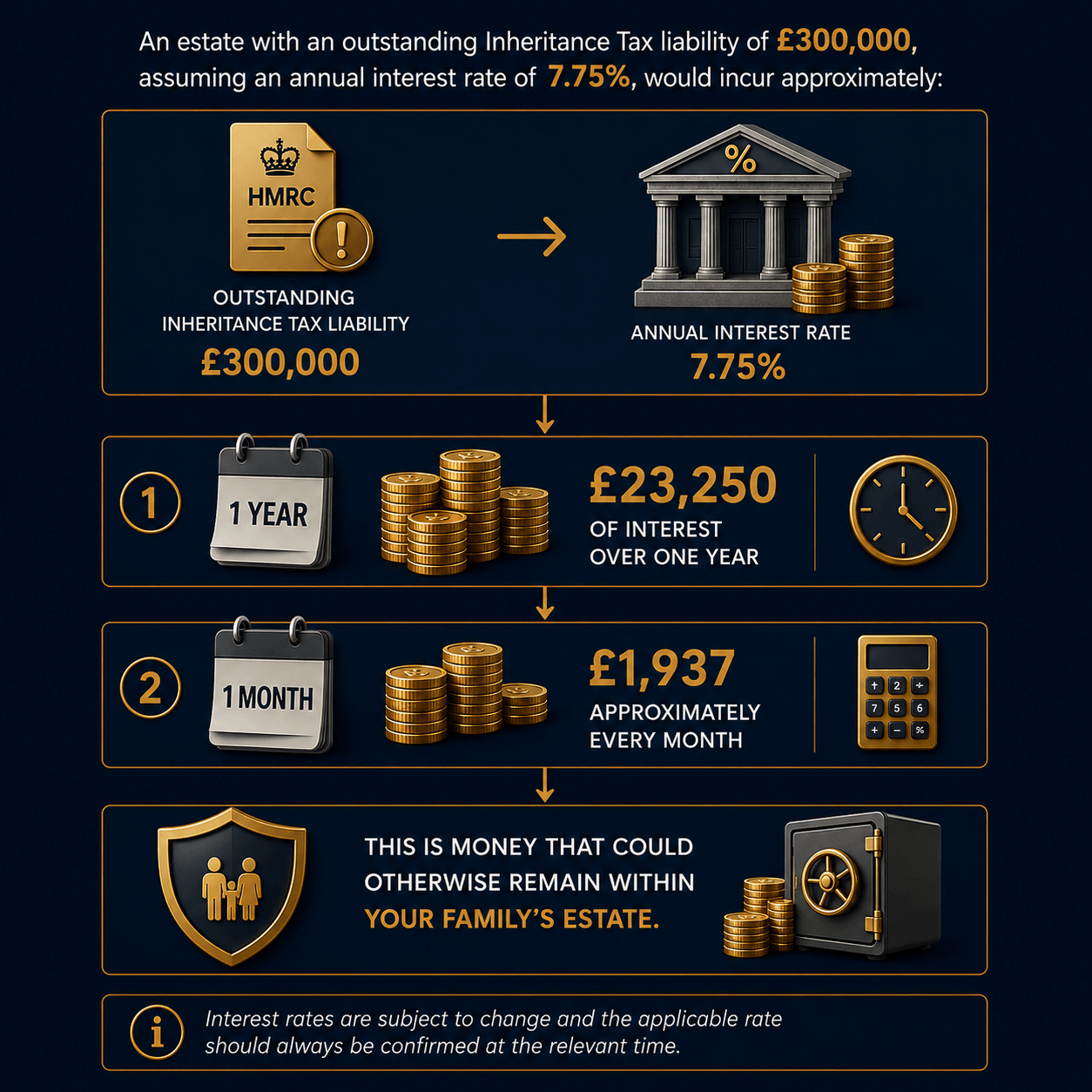
The Cost of Delay
Many families underestimate how expensive probate delays can become.
Where Inheritance Tax remains unpaid, HMRC charges interest on the outstanding balance.
Without A Probate Liquidity Fund™
Families commonly experience:
Forced property sales.
Investments sold during unfavourable market conditions.
Business assets sold below their true value.
HMRC interest charges.
Executors placed under financial pressure.
Beneficiaries disagreeing over which assets should be sold.
Reduced inheritance for future generations.
Months of unnecessary stress.

The Benefits
The Probate Liquidity Fund™ helps provide:
Immediate access to liquidity when it is needed most.
Greater flexibility during probate.
Reduced future Inheritance Tax exposure where appropriate.
Fewer forced asset sales.
Lower financial pressure on executors.
Faster settlement of estate liabilities.
Greater protection of family wealth.
Peace of mind for future generations.
Our Approach
Estate Architect coordinates this process with FCA-authorised financial advisers, tax specialists and legal professionals.
Where appropriate, we identify opportunities to move suitable assets into structures outside your personal estate that may both improve tax efficiency and create accessible liquidity for your family.
Importantly, these assets do not simply sit in cash.
They can remain professionally invested in accordance with your personal objectives and attitude to investment risk, continuing to work for you during your lifetime while also providing valuable flexibility for your executors in the future.
Every recommendation is tailored to your individual circumstances and forms part of your wider estate strategy.
The Cost Of Doing Nothing
Without the Probate Liquidity Fund™, your family may face:
A substantial Inheritance Tax liability.
Limited access to cash.
Frozen assets.
HMRC interest charges.
Forced property or investment sales.
Financial pressure on your executors.
Disagreements between beneficiaries.
A reduced inheritance for the next generation.
With the Probate Liquidity Fund™, your executors have immediate access to liquidity, allowing them to settle estate liabilities efficiently, avoid unnecessary interest, preserve family assets and administer your estate with confidence.


Estate Architect provides educational research and analysis relating to inheritance tax and estate planning concepts for UK residents. We do not provide regulated investment, tax, or legal advice and are not authorised or regulated by the Financial Conduct Authority (FCA). Where regulated advice is required, introductions may be made to authorised professionals.
© Estate Architect 2026