Why Do I Need Estate Architect?
“I Already Have an Accountant, Solicitor and a Financial Adviser”
Most conversations I have start in exactly the same way:
"I think I'm sorted. I already have an accountant. I already have a solicitor. I already have a financial adviser."
And honestly, that is exactly what I would expect.
By the time most families speak to me, they have spent decades building wealth.
They already have trusted professionals around them.
On paper, everything appears sensible.
You probably have a will.
You probably have done some gifting.
You have probably spoken to several people, and they’ve all told you that there isn’t much more you can do.
So naturally, you assume everything is already organised.
Unfortunately, this is where the hidden gaps often begin.
20 Things You Didn't Know About Estate Planning
Most people think their estate is sorted.
These 20 questions may make you think again.
The Problem Is
Not Bad Advice
The problem is not your accountant.
The problem is not your solicitor.
The problem is not your financial adviser.
In fact, most of the work from the advisers that I have seen, is usually very good.
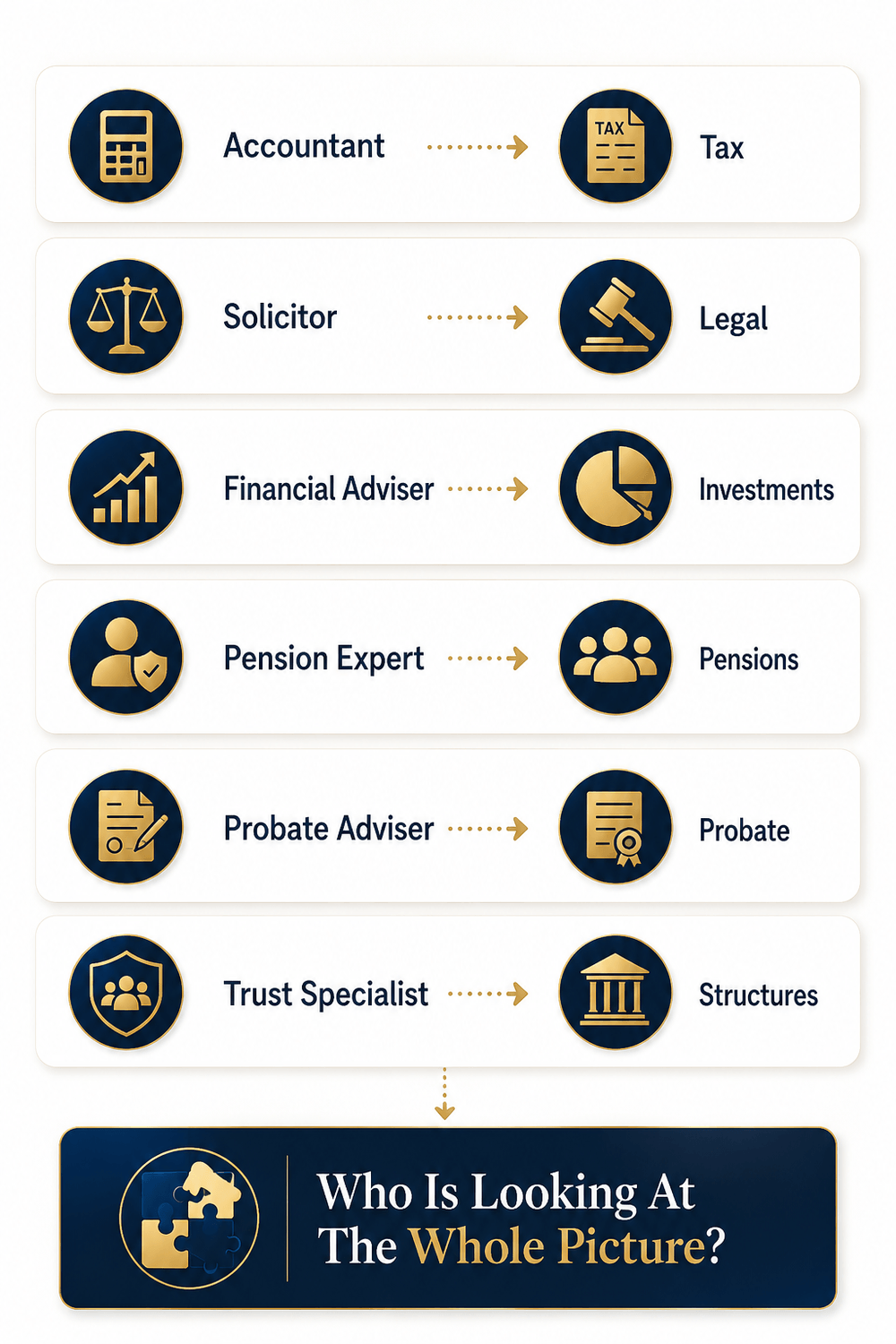
Your accountant does your accounts and tax returns.
Your solicitor focusses on property, wills and trusts.
And your financial adviser helps you with your investments.
So they're doing the right things.
But they are not specialist estate planners, which means nobody is looking across the entire estate for weaknesses.
Everybody is working on individual pieces of the puzzle.
But nobody is asking the most important question:
"How does it all fit together?"
What does Estate Architect Actually Do?
People often ask me, "If solicitors, accountants and financial advisers carry out the legal and regulated work, what exactly are we paying Estate Architect to do?"
This is what we do....
Estate Strategy & Planning
Every estate is different.
Before any implementation begins, we review your estate as a complete structure rather than as individual products, accounts or legal documents.
We will:
Review your estate as a whole, identifying how every asset, liability and family objective fits together.
Design the overall implementation strategy based on your circumstances and long-term objectives.
Decide the correct sequence for every stage of the implementation.
Identify weaknesses, conflicts, inefficiencies and missed planning opportunities.
Prioritise the actions likely to have the greatest impact on your estate.
Ensure every recommendation supports your wider estate planning objectives.
Professional Implementation
Estate planning often requires several different professionals working together.
Our role is to oversee that process and ensure every specialist understands both the strategy and their role within it.
Throughout your implementation, we will typically:
Meet with solicitors, accountants, financial advisers and other specialists where required.
Brief each professional on the agreed implementation strategy.
Review suitability reports and challenge assumptions where appropriate.
Coordinate meetings between the various professionals involved.
Monitor progress across multiple firms to ensure work is completed correctly and in the right order.
Liaise with professionals until each stage of the implementation has been completed.
Estate Verification & Protection
As your implementation progresses, every stage needs to be reviewed to ensure your estate remains consistent, accurate and aligned with the agreed strategy.
This will typically include:
Reviewing legal documentation before implementation is finalised.
Verifying ownership structures and beneficiary arrangements.
Reviewing inheritance tax calculations and implementation assumptions.
Completing Estate Stress Tests™ and Probate Liquidity Stress Tests™ where appropriate.
Maintaining your Lifetime Gift Verification Register.
Reviewing estate records for consistency, completeness and accuracy.
Ensuring every stage of the implementation supports the overall estate strategy.
Estate Research & Technical Review
Estate planning legislation continues to evolve.
Throughout your implementation, we continually review technical developments to ensure your strategy remains appropriate.
This may include:
Reviewing relevant HMRC legislation, guidance and technical updates.
Researching planning opportunities available under current legislation.
Assessing how proposed changes may affect other areas of your estate.
Considering alternative implementation approaches before recommendations are finalised.
Identifying risks and opportunities that may not be immediately apparent when advisers work independently.
Reviewing the wider impact of each implementation decision on your overall estate.
Ongoing Estate Control
Our role doesn't end once the first meeting has finished.
Throughout the implementation, we remain responsible for overseeing progress and ensuring every stage moves forward as planned.
This includes:
Remaining your primary point of contact throughout the implementation.
Overseeing the implementation from beginning to end.
Keeping every professional aligned to the agreed strategy and objectives.
Coordinating additional specialists if new issues arise during the implementation.
Monitoring progress, resolving implementation issues and keeping the project moving forward.
Keeping you informed throughout the implementation and answering any questions as they arise.
Taking overall responsibility for ensuring your estate restructuring is completed to the agreed standard.
Working With The Right Professionals
One of the biggest misconceptions is that Estate Architect must replace your existing advisers.
We don't have to.
In fact, we're happy to work alongside your existing accountant, solicitor or financial adviser.
However, complex estate planning often requires specialist expertise that many general advisers simply don't provide.
And that's why we have our own network of regulated specialists.
This saves you the time and energy finding the right professionals to fix your estate.
This Is What I Kept Seeing
After more than 25 years working in financial services, in the City of London, reviewing countless investment portfolios and speaking with literally, thousands of families, I started noticing the same pattern over and over again.
Families with excellent advisers were still experiencing avoidable problems.
Not because somebody had done something wrong. Not because anybody was incompetent.
But because nobody was responsible for joining everything together. Small gaps quickly became expensive problems.
One spouse held too much wealth.
Pensions were often considered in isolation from the wider estate.
Documents became fragmented.
Liquidity was ignored.
Children had no idea where anything was.
Individually these problems looked small.
Together they became significant.
What I've learned over 30 Years and 100+ Probates
There is something else that makes my approach very different.
I don't provide regulated financial advice or personal recommendations, which means I don't have a product, fund or particular solution to sell you.
My job is to look at your estate as a whole.
To identify the weaknesses, understand how everything fits together, explore the available options and, where appropriate, bring in the right regulated or specialist professionals to carry out the work.
Over nearly 30 years in financial services, I have worked across investment management, trading, compliance and wealth management, including more than 16 years running an FCA-regulated firm.
During that time, I managed or oversaw more than 1,000 client portfolios and witnessed more than 100 probate cases involving clients and their families.
That experience taught me something important.
The biggest problems were rarely caused by one bad decision.
They were usually caused by small gaps between otherwise sensible decisions.
A pension considered separately from the estate.
Property structured without considering what happens later.
Investments held in the wrong ownership.
Documents that nobody could find.
Insufficient liquidity when inheritance tax became payable.
Different professionals doing their jobs correctly — but nobody responsible for making sure everything worked together.
I saw the same problems repeatedly.
And because I often knew the families before and after somebody died, I also saw what happened when those gaps were discovered too late.
That perspective changed the way I thought about estate planning.
The Estate Needs Someone Looking at the Whole Picture
Most families already have good professionals.
If you have advisers you trust, that's a good thing. We can work alongside them.
Where additional expertise is required, I can coordinate with carefully selected professionals across pensions, investments, property, trusts, tax planning, legal work, mortgages and probate.
But somebody still needs to take responsibility for the estate as a whole.
Someone needs to understand the objective.
Someone needs to identify the gaps.
Someone needs to make sure the different pieces fit together.
And someone needs to keep the process moving until the work is completed.
That is the role of your Estate Architect.
We're talking about wealth you may have spent a lifetime building.
It deserves more than a collection of disconnected decisions.
It deserves a coordinated plan.
So if you're still wondering whether I can help you...
Yes, I can help you.
Estate Architect provides educational research and analysis relating to inheritance tax and estate planning concepts for UK residents. We do not provide regulated investment, tax, or legal advice and are not authorised or regulated by the Financial Conduct Authority (FCA). Where regulated advice is required, introductions may be made to authorised professionals.
© Estate Architect 2026